
About this event
Most hiking training assumes the answer is more hiking. Walk further, walk more often, and the legs will sort themselves out. That works up to a point, but it leaves whole muscle groups untouched - and those are usually the ones that fail on a long day in the hills.
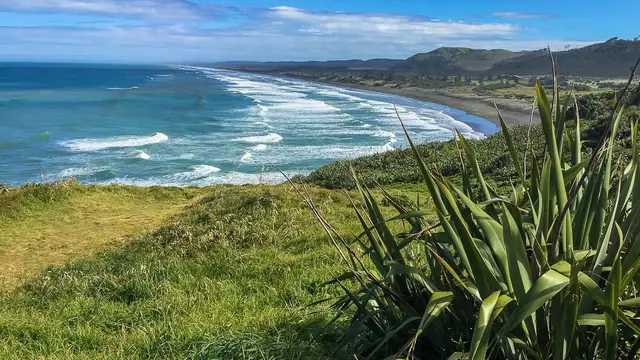
This session is built around that gap, and around a second one: pace. Thirteen kilometres north along Muriwai on firm sand, with five walking techniques worked in as short blocks along the way, and three stretches of the walking between them run at a called speed. Each drill targets something that ordinary forward walking never loads properly. The pace blocks target the judgement that decides how much of it you have left at the end.
The drills are called as a group, roughly every twenty to twenty-five minutes, with normal walking in between. Total drill time is about forty minutes spread across four hours. The gaps are not filler - these movements fatigue quickly, and form collapses if you stack them back to back.
WHAT WE WORK ON
Reverse walking, ten minutes. Walking backwards loads the quadriceps eccentrically, which is exactly what a long descent does, but without the same compression through the kneecap. If descents are where your knees complain, this is the drill that matters most. It also removes visual feedback from each step, which does useful things for balance.
Zigzag, ten minutes. Cutting diagonals across the beach reproduces the demands of switchbacks. Every change of direction takes the ankle through inversion and eversion - the same movement that gets overloaded when you catch a root or step onto a loose rock. Turns should be deliberate and rounded, not sharp.
Lateral side-step, eight minutes, four on each side. Sideways movement targets the glute medius and the hip abductors. These carry you across sidehill traverses, and they are where most hikers are weakest. Underworked hip abductors are also a common source of knee pain late in a long day.
Heel walk, five minutes. Toes lifted, weight on the heels, loading the tibialis anterior down the front of the shin. This is the muscle that stops your foot slapping down on a descent, and its weakness is closely tied to shin splints. Kept short on purpose - it burns fast.
Toe walk, five minutes. Up on the forefoot, loading calves and Achilles. The shortest block of the five, deliberately. Most people can hold it far longer than is sensible, and the soreness turns up the following day.
PACE
The other half of a long day is pace, and it is the part most walkers get wrong in one direction or the other. Some push hard early and spend the last two hours paying for it. Others have never had to hold a deliberate speed at all, and simply walk at whatever the ground allows. Neither is a fitness problem, which is why more hiking does not fix it.
So three stretches of the ordinary walking are run at a set pace instead of a chosen one. They add no time to the session - we are walking anyway - and no distance. Only the speed is decided for you.
Metronome slow, twenty minutes on the way out. Single file behind the slowest walker, around four kilometres an hour, nobody overtakes. Short stride, quicker cadence, quiet feet. This is descent control without the descent: the quadriceps work steadily rather than braking hard on every step. Strong walkers usually find it the hardest twenty minutes of the day.
Pace rotation, fifteen minutes. The leader changes every three minutes and has to hold a called speed. Most of us judge our own pace badly, and fifteen minutes of this makes that obvious. Everyone gets a turn setting the tempo rather than following it.
Brisk block and reset, twenty-five minutes on the return leg. Fifteen minutes at a genuine six kilometres an hour, then straight back down to metronome pace for ten, with no drift. The push is there for the walkers who want it. The reset is the actual lesson - coming down off a fast pace on purpose, before your legs make that decision for you.
WHY SAND
Soft ground costs roughly one and a half to two times the energy of firm footing. That gives a genuine aerobic load at a slow pace with almost no impact through the joints - conditioning without the pounding. We work the firm sand below the high tide line, where the surface is compact enough for clean technique. Low tide around ten in the morning means the whole session sits on good ground.
WHAT TO EXPECT
Four hours, out and back, flat the entire way. We turn at the halfway point regardless of how the group is moving, so nobody ends up stranded at the far end. There is a stop at the turnaround for lunch.
Skipping a drill is entirely fine and needs no explanation. The group regroups after each block before carrying on.
The pace blocks work the other way round. Holding back when you could comfortably go faster is the point of them, not a courtesy to the rest of the group.
Photos
No photos yet. Attendee photos will appear here once the event is underway.
What Wakahi Walks does
- Organise the event from start to finish
- Lead the group on the track
- Book huts, campsites or lodges (as applicable)
- Arrange logistics — transport and carpool coordination
- Group coordination and safety planning
- Organise training events
Your contribution covers this organising work — not just the hut bookings.
Logistics
- Departure point: Muriwai Beach main car park, Motutara Road. Sealed car park on the dune edge with direct beach access.
- Hike start: 9:00 am
Costs
| Item | Amount (NZD) | Group Booking |
|---|---|---|
| Group contribution | $2 | No |
Pre-event and post-event group dinners
We usually meet for a group dinner before the walk and a celebration dinner after it. Both are optional, but most attendees join.
What to bring
Gear
- Sturdy shoes or trail runners - no sandals
- Windproof outer layer
- Warm mid layer
- Sun protection - hat, sunglasses, sunscreen
- 1.5 L water
- Personal first aid kit
Food
- Snacks for during the session
- Lunch for the turnaround stop
Important notes
- This is a training session rather than a scenic walk
- Drills are optional and sitting one out is entirely acceptable - the group waits and regroups before moving on
- The pace blocks are different: they are group blocks, and holding back when you could go faster is the point of them
- We turn at the halfway mark regardless of pace, so nobody is left at the far end
- Low tide falls around 10:00 am, which keeps the entire session on hard-packed sand
Safety
- Your safety is your own responsibility. Judge your own fitness honestly and ease off or stop a drill if it does not feel right
- Muriwai is an exposed west coast beach with strong surf and rips. Stay well above the waterline and out of the water at all times
- Wind and windchill can be severe in September even on a clear day. Carry the windproof layer regardless of the forecast
YOUR SAFETY IS YOUR RESPONSIBILITY
Useful links
Reserve your spot
19 of 20 spots remaining.
Please log in to sign up for this event.
Who's going (1)
-
 Rafick Organiser
Discussion
Questions about this event, or want to chat with others going? Join the conversation on our forum.
Go to the forum topic