
Walking Among Ruins
Thessaloniki’s Ancient Past
In Thessaloniki the ancient and the everyday share the same street — a 1,700-year-old arch over the traffic, a Roman palace beneath the apartment blocks. A walk among the old, the beautiful, and the gloriously imperfect.
In Thessaloniki you can step out of a 1960s apartment block, turn the corner, and walk straight into the fourth century. There’s no fence around most of it, no ticket booth, no clean separation between “the monument” and “the city.” A Roman arch stands over a pedestrian crossing. A wall built before Christianity sits in a sunken lot with washing lines and balconies looming over it. You walk between the old and the new constantly, and after a few days it stops feeling strange and starts feeling like the most natural thing in the world.
I went to Thessaloniki to walk, and the walking kept delivering me to these places — not as set-piece attractions, but as things you simply pass on the way to somewhere else. This is what that’s like, and a few honest thoughts about why it matters that a city keeps its ancient stones alive instead of clearing them away.
All photographs in this post were taken by me on foot in Thessaloniki.
An arch you walk under, not around
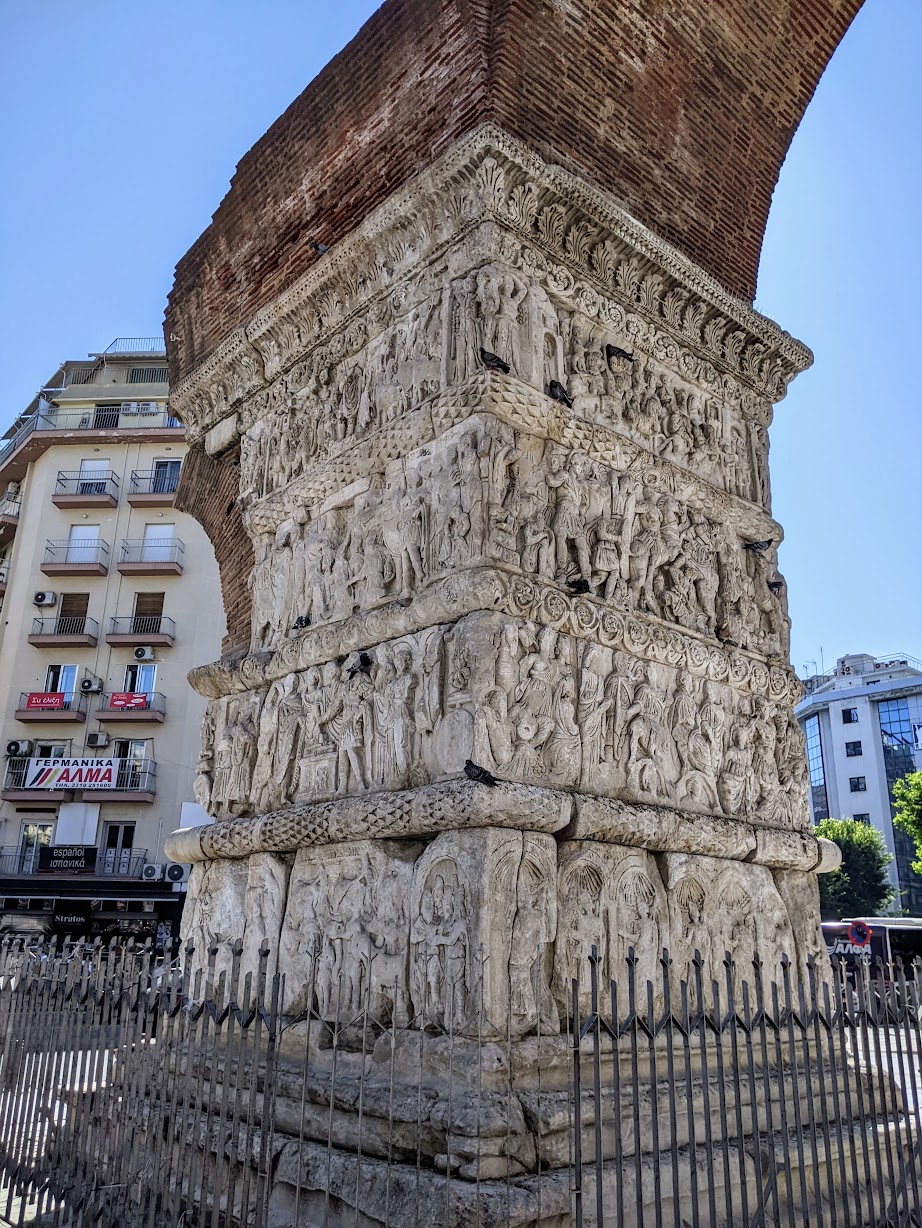
The Arch of Galerius — locals call it the Kamara — is the heart of it. Built around 300 AD to celebrate the emperor Galerius’s victory over the Persians, it once spanned a great processional road. Today it spans a busy pedestrian street, and people stream under it on their way to work, to the shops, to the seafront. Its marble piers are carved with battle scenes packed with figures — soldiers, elephants, the emperor himself — worn soft by seventeen centuries of weather and hands.
What struck me wasn’t just the carving. It was that the arch is simply part of the street. You can stand with your hand on a Roman relief while a delivery scooter buzzes past behind you. Nobody hurries you along. The monument and the city aren’t in competition; they share the same ground.
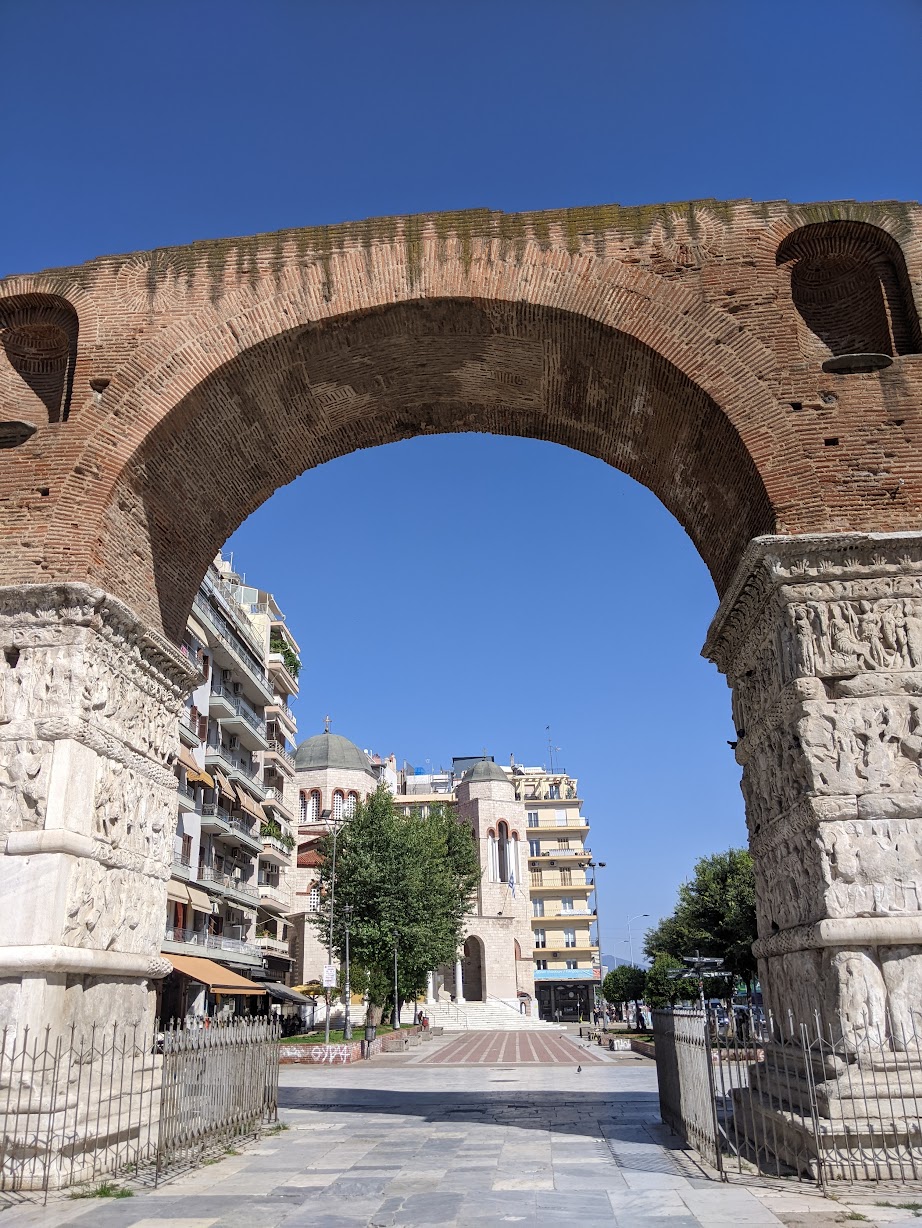
Get close and the detail rewards you: tier after tier of carved marble at the base, each band a different scene, the brick mass of the arch rising above. A young woman walked through the frame as I photographed it, phone in hand, entirely unbothered by the empire at her shoulder. That’s the everyday miracle of the place.
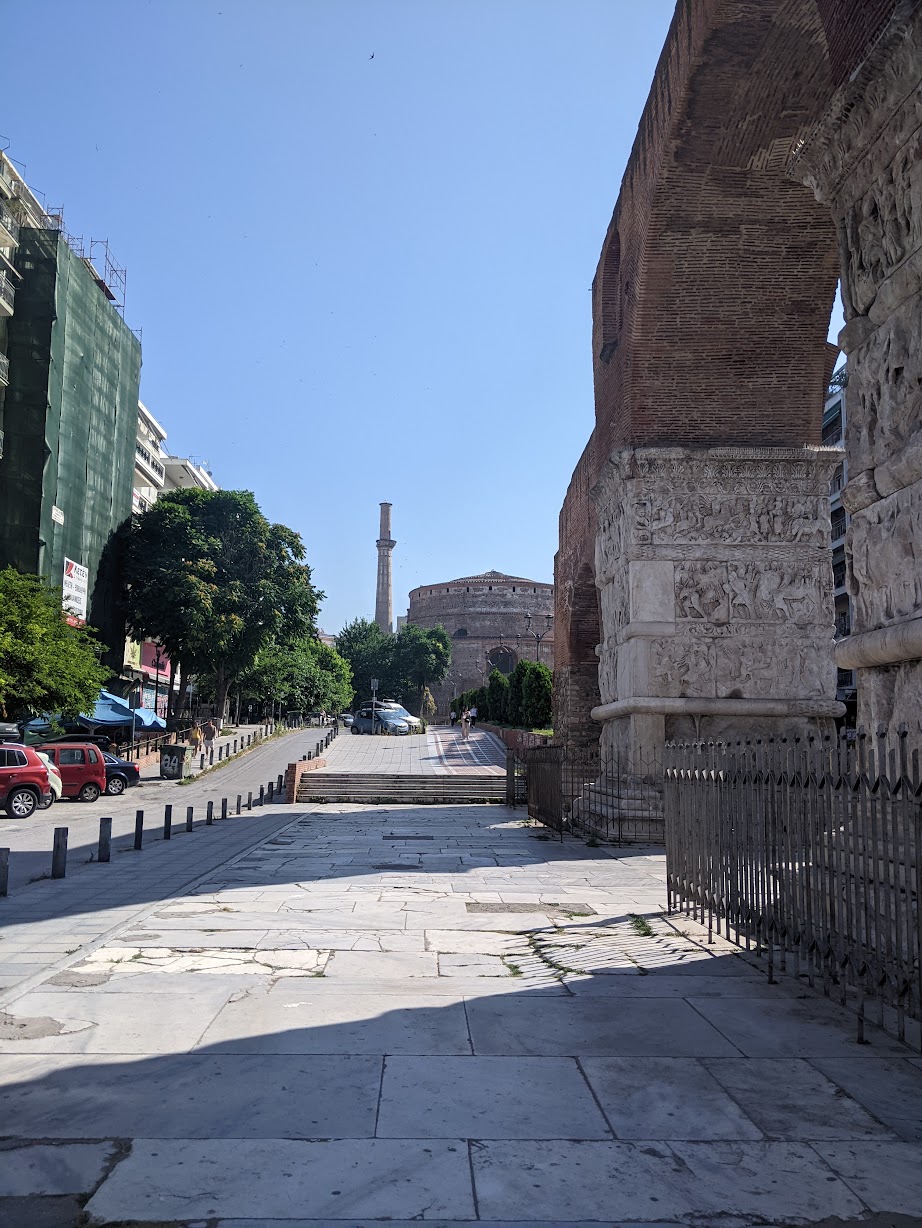
The Rotunda down the avenue
Look through the arch and down the avenue and you see the Rotunda — a vast cylindrical building also raised under Galerius, around 306 AD, and one of the oldest structures of its kind still standing anywhere. It has been, in turn, a Roman monument, a Christian church, a mosque (the lone minaret beside it still survives), and is now a monument and occasional church again. Few buildings carry their whole layered history so plainly on the outside.
That sightline — the Kamara in the foreground, the Rotunda framed beyond, a modern street running between them — is Thessaloniki in a single view. Three eras, one glance.
A palace beneath the apartment blocks
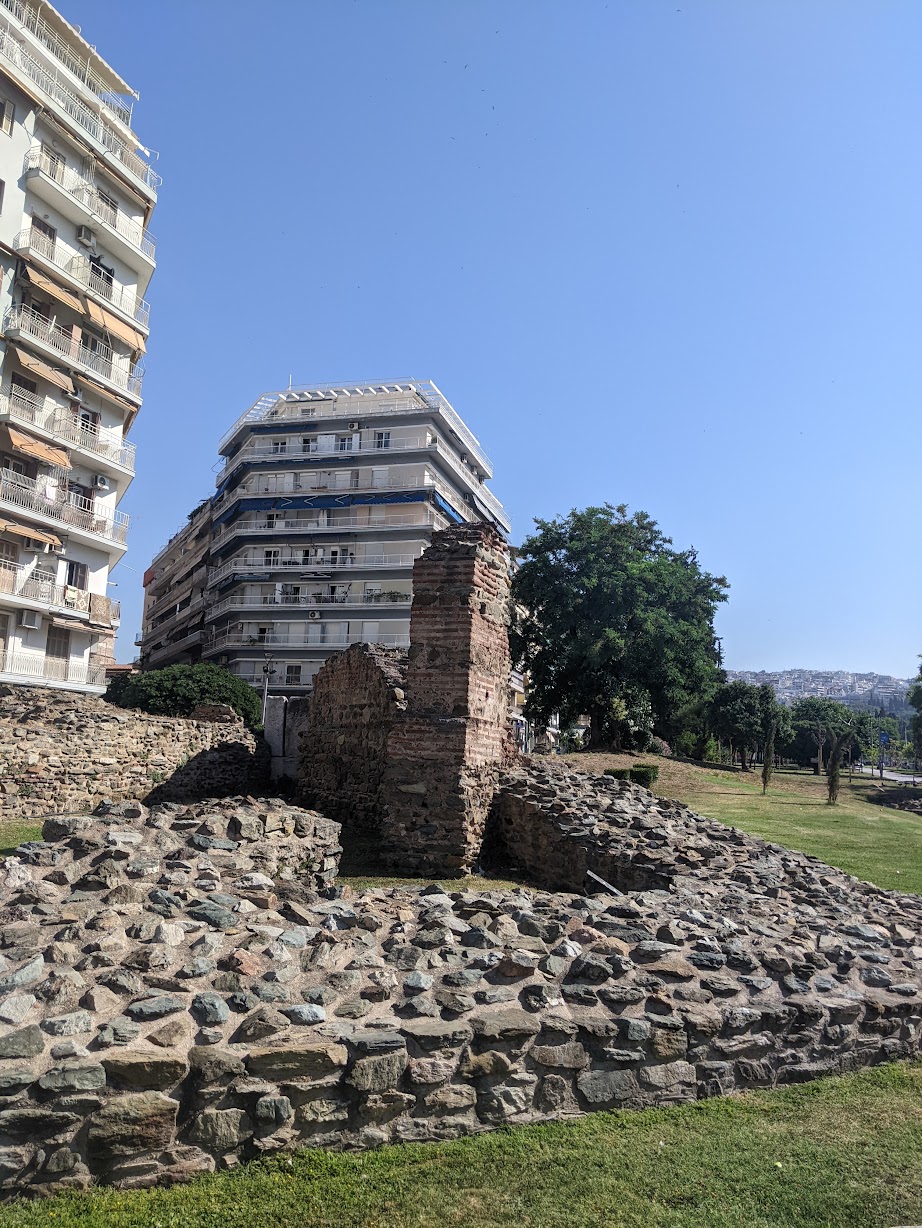
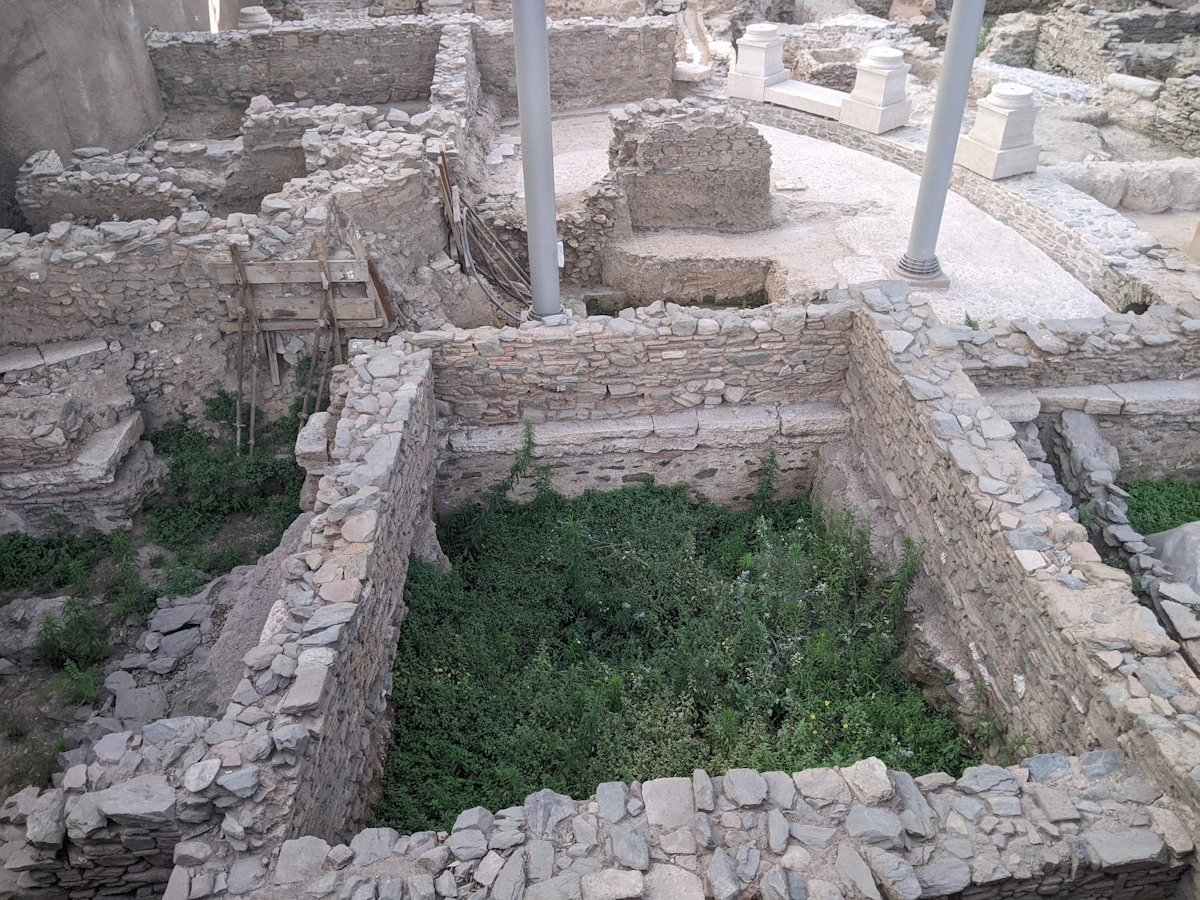
A short walk away is the most striking contrast of all. The Palace of Galerius — the emperor’s own complex — lies excavated in a sunken precinct, several metres below the modern street, ringed entirely by apartment buildings. You lean on a railing and look down into the fourth century while someone’s laundry dries on a balcony directly above the ruins.
It would be easy to call it undignified — an emperor’s palace hemmed in by concrete, weeds growing between the brick chambers. I found it the opposite. The city didn’t bulldoze the ruins to build, and it didn’t freeze the whole quarter to preserve them. It did the harder, humbler thing: it let them coexist. The result is honest in a way a manicured archaeological park never is.
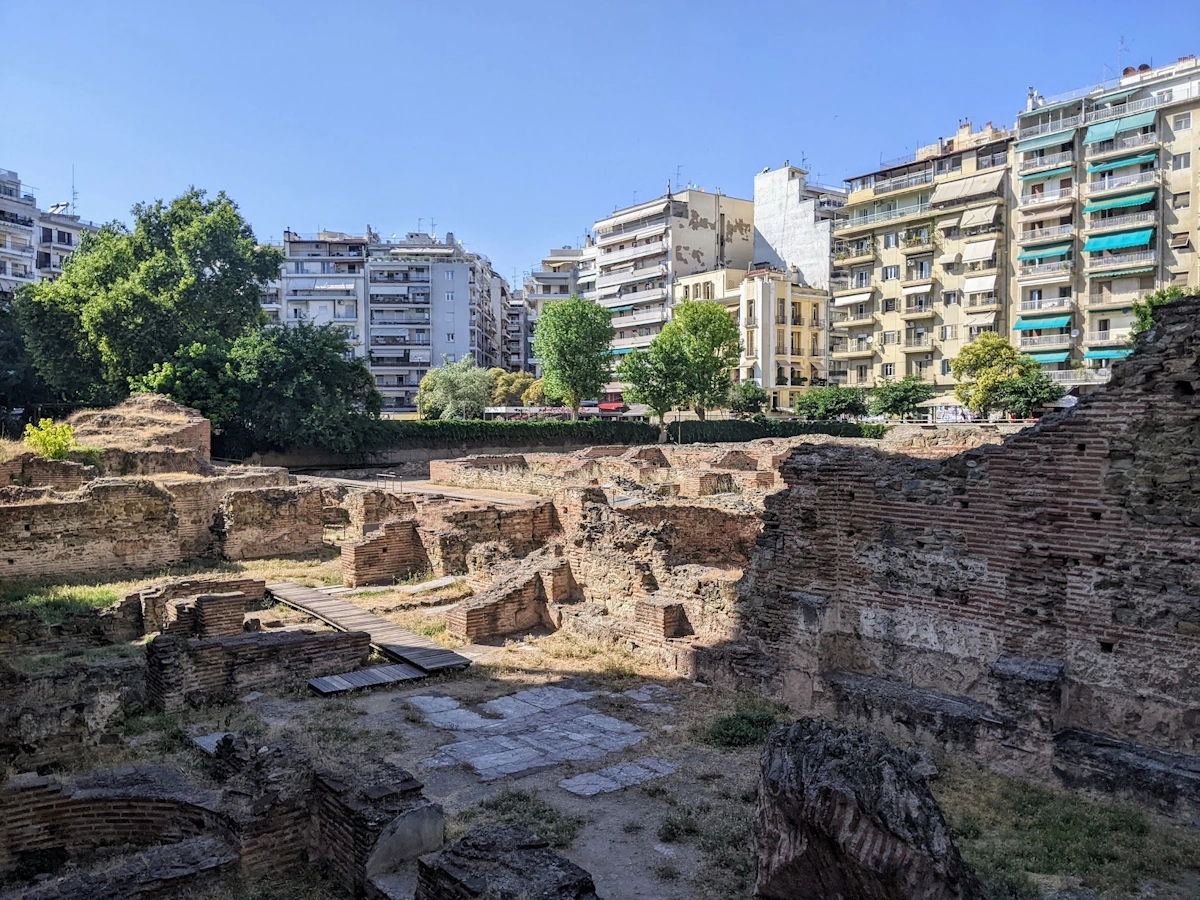
“You lean on a railing and look down into the fourth century while someone’s laundry dries on a balcony directly above the ruins.”
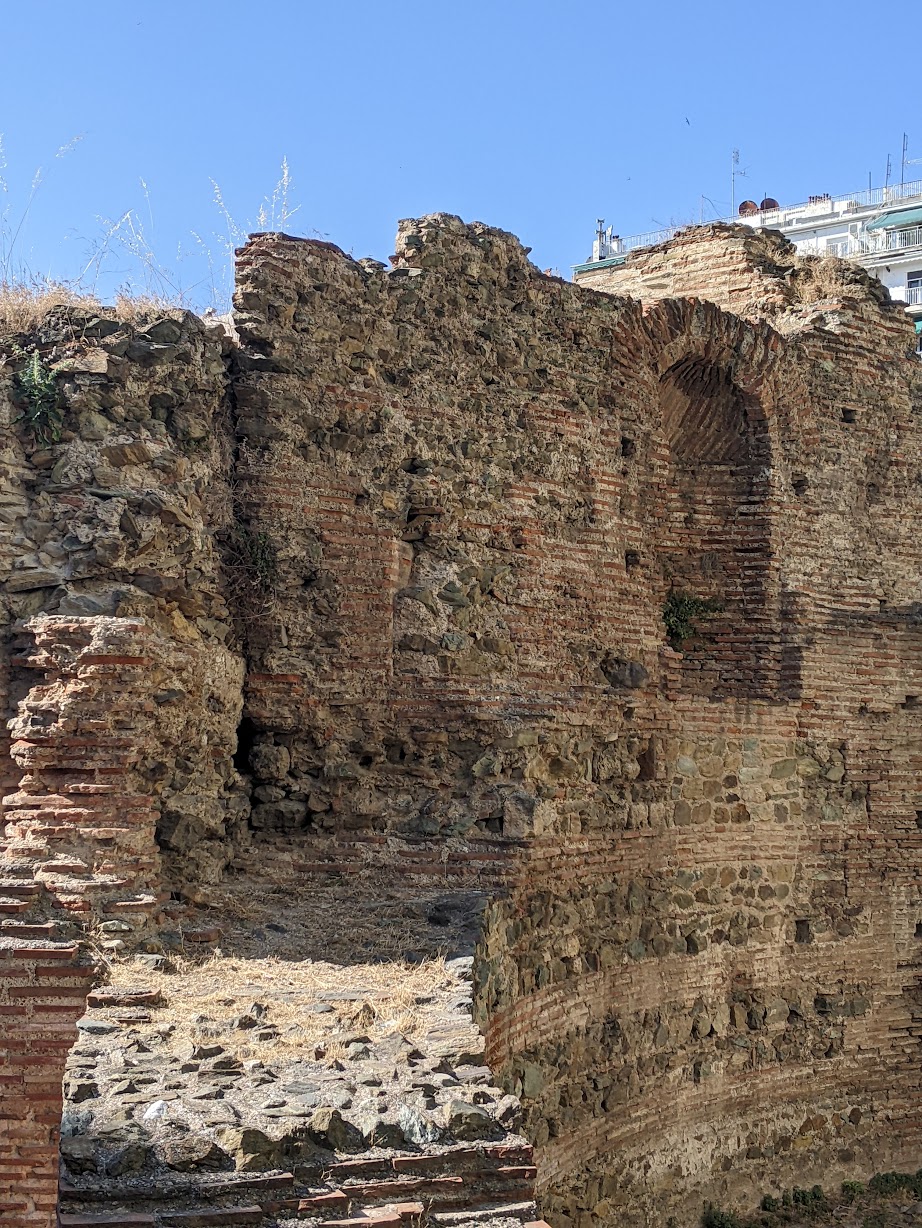
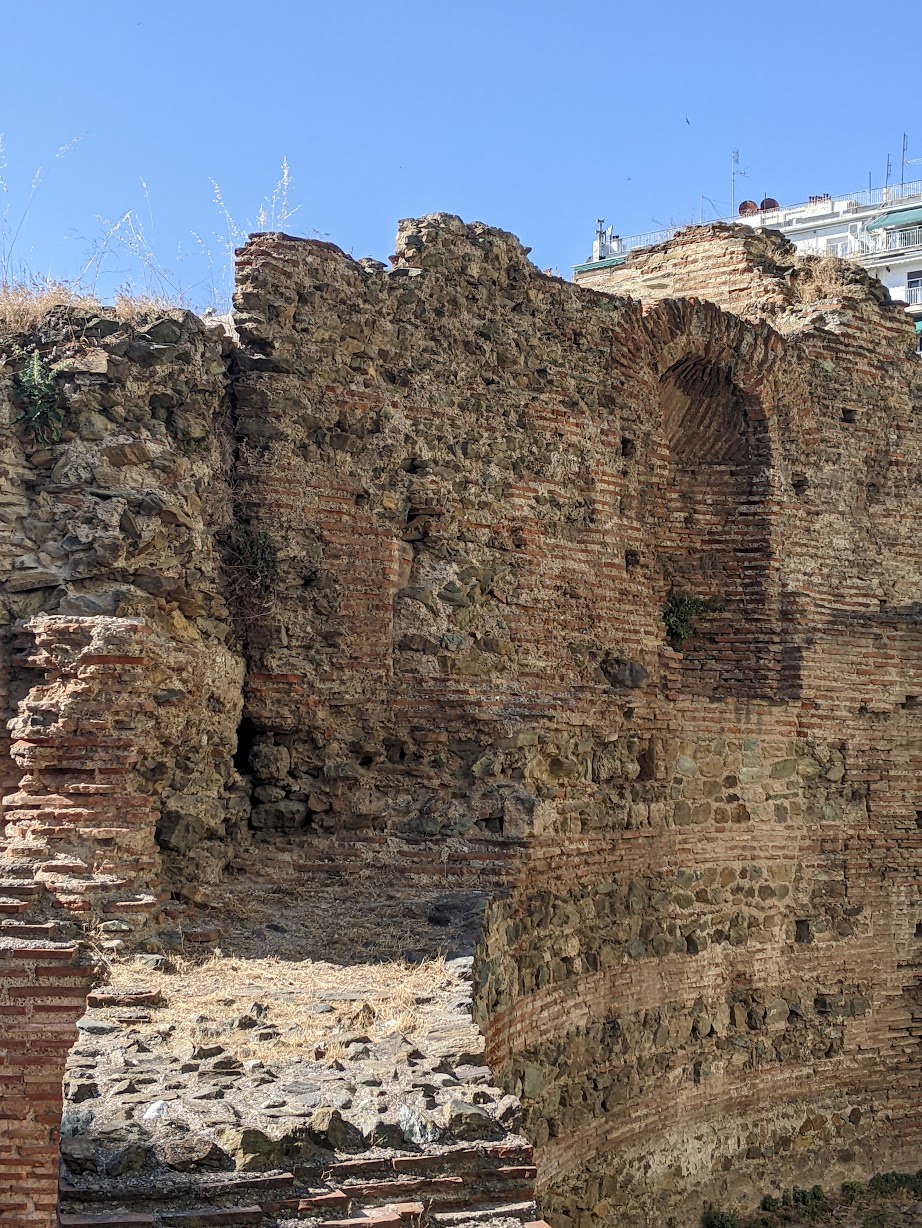
Rafick, walking ThessalonikiUp close the walls tell their own story — bands of Roman brick alternating with rubble stone, a building technique you can read like tree rings. A vaulted passage still runs into the dark, its ceiling intact after all this time. You can walk through spaces emperors walked through, with no glass between you and the brick.
Tap any image to enlarge.

A church that never stopped being a church
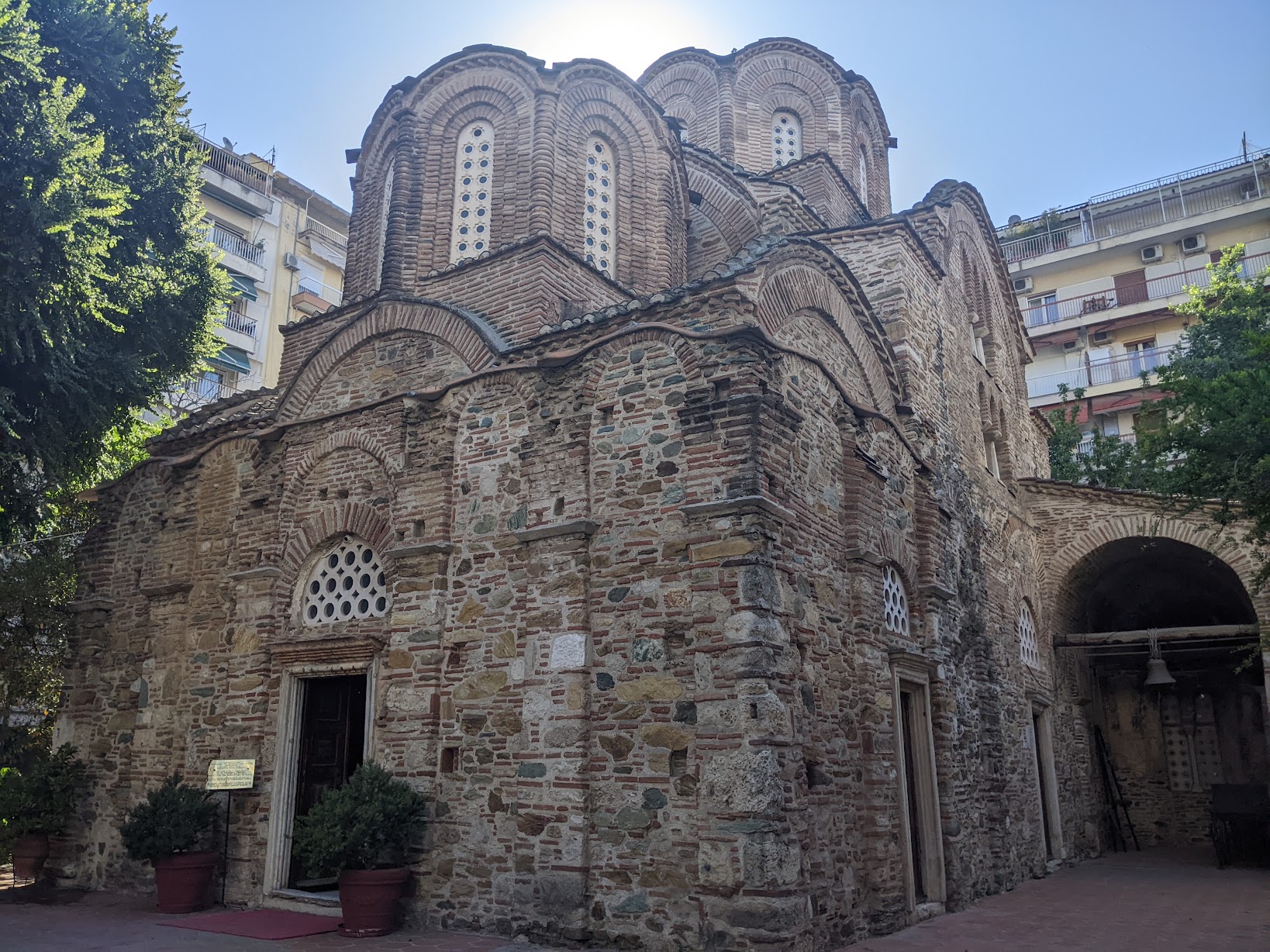
Not everything here is a ruin. The Church of Saint Panteleimon — one of the fifteen Palaeochristian and Byzantine monuments of Thessaloniki inscribed on the UNESCO World Heritage list — has been standing since the late thirteenth century. Its brick-and-stone walls, layered domes, and patterned masonry are textbook late-Byzantine, and it is still in use: a working church, doors open, candles lit, the same purpose it was built for some 700 years ago.
There’s a particular feeling in a building that has never been abandoned — never turned into a museum, never roped off. Continuity, not preservation. It has survived earthquakes, the centuries of Ottoman rule, fires, and the enormous blaze of 1917 that gutted much of the city. And it’s still doing exactly what it was made to do.
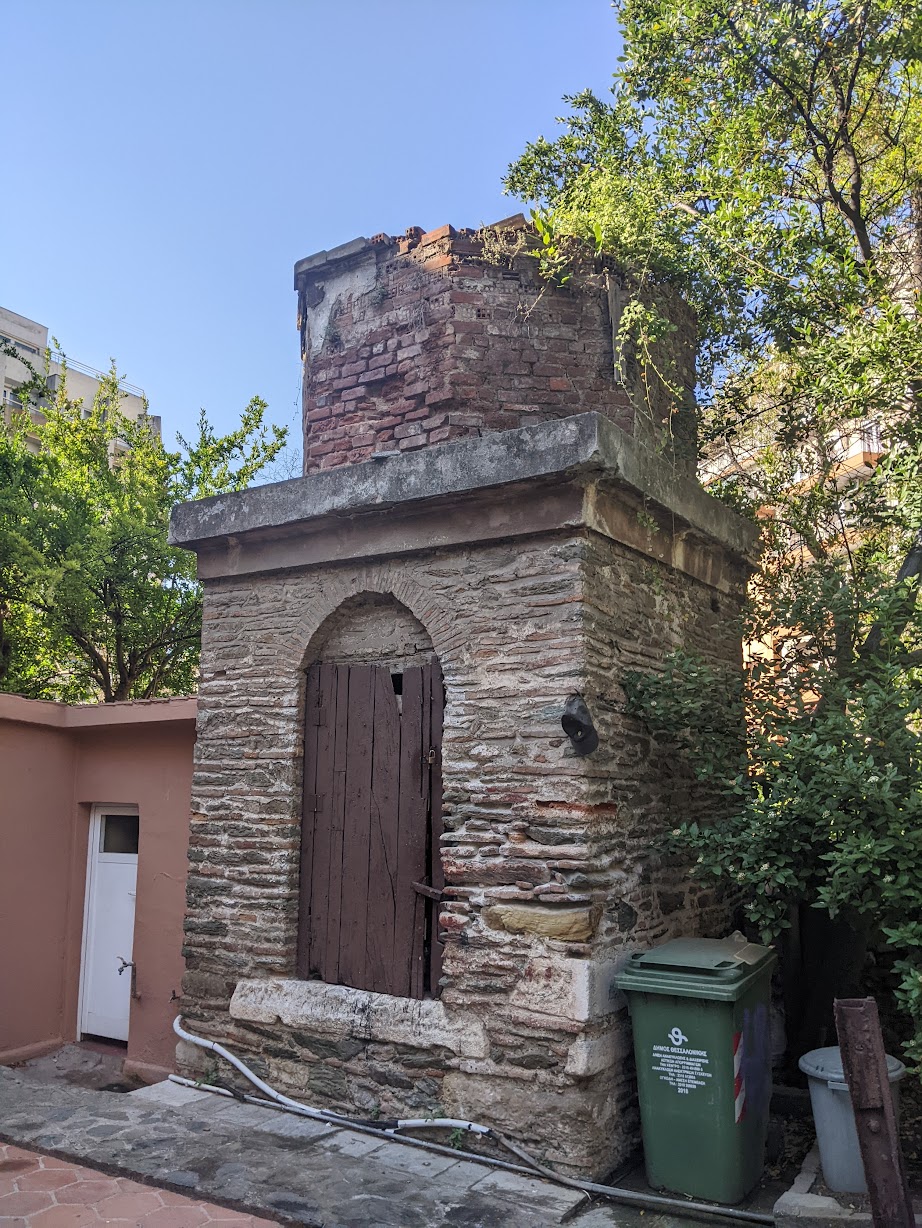
The same instinct runs through Ano Poli, the Upper Town, where Ottoman-era fountains still stand in the lanes — some recently restored to give drinking water again. A centuries-old fountain next to a wheelie bin isn’t a failure of preservation. It’s preservation working the way it should: the old thing kept in use, not embalmed.
Why it matters that none of this was cleared away
Here is the thought I kept coming back to, walking between all of it. Thessaloniki could have done what countless growing cities have done — cleared the awkward old stones, filled the sunken lots, built clean and modern over the top. It didn’t. It built around them, above them, alongside them. The inconvenience of the past is woven into the daily life of the present.
I come from a part of the world where the human-built past is measured in a couple of hundred years. Many countries simply don’t have monuments this old — not because their people built nothing, but because what was built was wood, or was cleared, or was never meant to last. To stand with your hand on a wall raised seventeen centuries ago is a rare privilege, and it’s easy to forget how rare when you live among it every day.
Which is exactly why destroying such things is so much graver than it looks. To knock down an ancient monument isn’t to clear a plot of land. It’s to erase the memory of everyone who quarried the stone, fired the brick, carved the relief, and raised the thing by hand. Those people left no diaries and no portraits. The monument is their record — the one proof that they were here, that they were capable of marvels. Erase the stone and you erase them a second time, this time for good.
Preservation, then, isn’t nostalgia or tourism. It’s a form of respect across time — a refusal to let the people who came before us be forgotten just because their buildings are in the way. Thessaloniki understands this in a way that doesn’t announce itself. It simply lets the ancient and the everyday share the street, and trusts its citizens to live alongside the evidence of who came first.
The beautiful and the ugly, on the same walk
None of this is tidy, and that’s the joy of it. On a single walk you pass a sublime carved arch and a graffiti-scarred wall, a UNESCO church and a crumbling lot, golden Byzantine brick and grey 1970s concrete. The beautiful and the ugly sit side by side, and the contrast doesn’t diminish the beauty — it sharpens it. A perfect monument behind glass in an empty park moves you less than the same monument standing, scuffed and alive, in the middle of a city that needs the space.
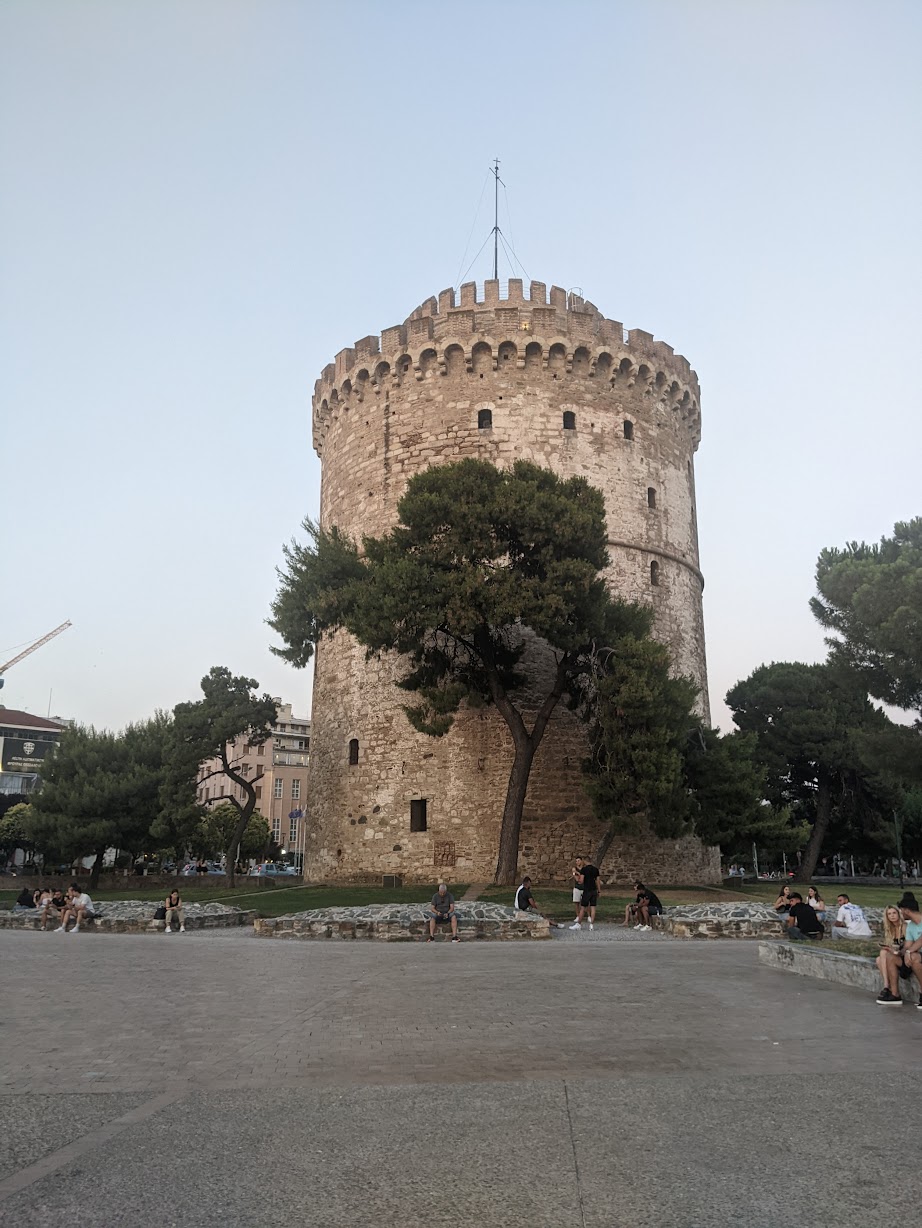
I ended several evenings at the White Tower on the waterfront — the city’s great Ottoman-era landmark, once a prison, now its calm symbol — watching people gather on the grass around it as the light went soft. Six centuries old, and on an ordinary evening it’s just the nicest place in town to sit. That, in the end, is what Thessaloniki taught me: the past is at its most powerful not when it’s fenced off and revered, but when it’s simply, stubbornly, still here — part of the walk, part of the day, part of the life of the people who inherited it.
You don’t need a guidebook to feel any of this. Walk the centre, walk up into Ano Poli, follow the avenues between the arch and the sea, and let the old stones find you. They’re not hiding. In Thessaloniki, they never have been.
Have you walked Thessaloniki, or somewhere the ancient and the everyday share the street?
Log in or sign up to share your thoughts below — we’d love to hear from you.
This post may contain affiliate links. Wakahi earns from qualifying purchases at no extra cost to you.