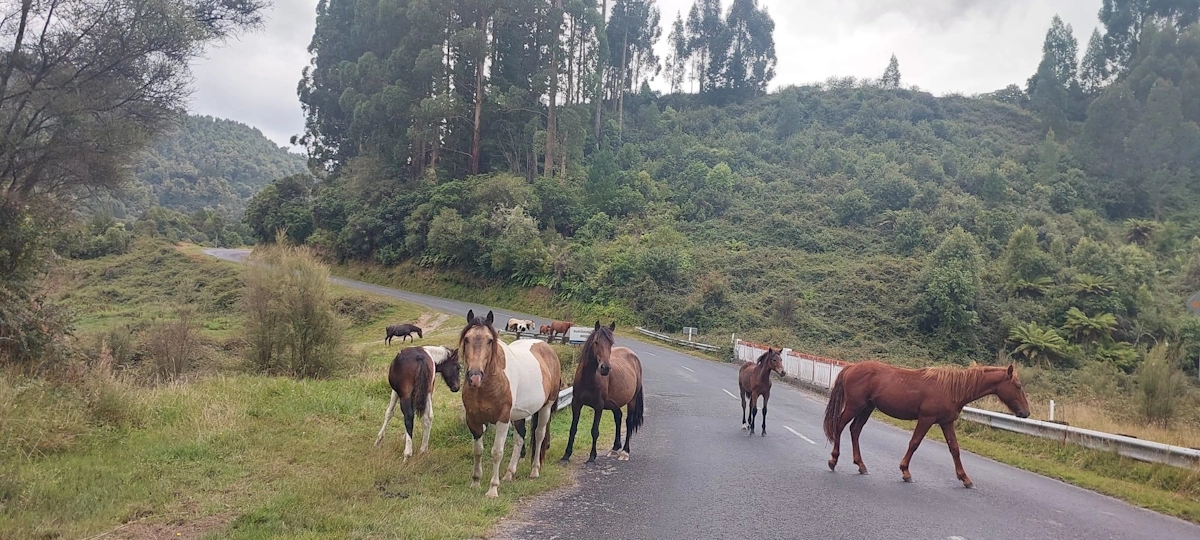
Lake Waikaremoana: A Journey into the Heart of Te Urewera
The air hung thick with the scent of damp earth and ancient trees as I stood at the edge of Lake Waikaremoana. A silver sheen coated the still water, reflecting the towering, emerald-clad peaks of Te Urewera National Park. I was about to embark on a journey I’d dreamt of for years – a multi-day hike around this sacred lake, a place steeped in Māori history and brimming with untamed beauty. The promise of solitude, challenging terrain, and profound connection with nature tugged at my soul, a siren song I couldn’t resist.
Trail Overview & Quick Facts
The Lake Waikaremoana Track, one of New Zealand’s Great Walks, is a 46-kilometer loop that circumnavigates the stunning Lake Waikaremoana. Here’s a quick rundown:
- Distance: 46 kilometers (28.6 miles)
- Difficulty: Moderate to Challenging
- Duration: Typically 3-4 days
- Highest Point: Panekire Bluff (1180 meters / 3871 feet)
- Terrain: Varied, including forest tracks, boardwalks, and some steep climbs.
The Journey
Day 1: Onepoto to Panekire Hut (10.4 km)
The first day was brutal, but rewarding. From the Onepoto carpark, the track immediately began its ascent towards Panekire Bluff, a climb that tested my lung capacity and leg muscles. The forest was alive with birdsong – the melodic calls of tūī and the cheeky chatter of fantails. Sunlight dappled through the canopy, creating an ethereal glow on the forest floor. As I gained altitude, glimpses of the lake emerged through the trees, each one more breathtaking than the last. Finally, after what felt like an eternity, I crested the bluff. The view was simply stunning – the entire expanse of Lake Waikaremoana stretched out before me, a vast, shimmering sapphire surrounded by a sea of green. Panekire Hut offered a welcome respite, and I shared stories with fellow hikers as we watched the sun dip below the horizon, painting the sky in fiery hues.
Day 2: Panekire Hut to Waiopaoa Hut (12 km)
Day two was a gentler descent, a welcome reprieve for my weary knees. The track wound its way through native beech forest, the air thick with the scent of moss and decaying leaves. The forest floor was a tapestry of ferns and fungi, a miniature world of intricate detail. I stopped frequently to admire the towering trees, their gnarled branches reaching towards the sky like ancient guardians. Waiopaoa Hut was nestled in a secluded cove, a tranquil spot perfect for swimming. The water was icy cold, but invigorating, washing away the aches and pains of the day. As darkness fell, the stars emerged in full force, a breathtaking display of celestial brilliance, far from the light pollution of civilization.
Day 3: Waiopaoa Hut to Marauiti Hut (9 km)
The third day brought a change of scenery, as the track followed the shoreline of the lake. The trail undulated gently, offering stunning views across the water. I passed secluded beaches, perfect for a quiet moment of reflection, and crystal-clear streams, where I refilled my water bottle. The birdlife was abundant, and I spotted kererū (native wood pigeons) and kākā (native parrots) flitting through the trees. Marauiti Hut was a small, intimate shelter, and I enjoyed a peaceful evening, reading by the light of my headlamp, lulled to sleep by the gentle lapping of the waves.
Day 4: Marauiti Hut to Onepoto (14.6 km)
The final day was the longest, a challenging push back to the starting point. The track climbed steadily away from the lake, offering panoramic views of the surrounding landscape. The forest became denser, and the air grew heavy with humidity. I encountered several steep climbs and descents, testing my stamina and resolve. As I neared Onepoto, the familiar sight of the carpark brought a wave of relief and a tinge of sadness that my journey was coming to an end. I had completed the Lake Waikaremoana Track, a feat that filled me with pride and a deep sense of accomplishment.
Highlights & Memorable Moments
- The view from Panekire Bluff: An unforgettable panorama of Lake Waikaremoana.
- Swimming in the icy waters of Waiopaoa: A refreshing and invigorating experience.
- The star-filled nights: A breathtaking display of celestial beauty.
- The solitude and tranquility of the forest: A chance to reconnect with nature and myself.
- The camaraderie of fellow hikers: Sharing stories and experiences with like-minded individuals.
Challenges & Lessons Learned
- The climb to Panekire Bluff: A physically demanding challenge that tested my fitness and endurance.
- The unpredictable weather: Be prepared for rain, wind, and sunshine, sometimes all in the same day.
- The weight of my pack: Pack light and only bring essential items.
- The importance of proper footwear: Invest in sturdy hiking boots that provide good ankle support.
- The need for patience and perseverance: Hiking can be challenging, but the rewards are well worth the effort.
Practical Tips for Future Hikers
- Book your accommodation in advance: The huts along the track can fill up quickly, especially during peak season.
- Obtain a Great Walks Pass: This pass allows you to stay in the huts along the track.
- Pack for all types of weather: Be prepared for rain, wind, and sunshine.
- Bring plenty of water and snacks: There are limited opportunities to resupply along the track.
- Wear sturdy hiking boots: The track can be rough and uneven.
- Learn about Māori culture and history: Lake Waikaremoana is a place of great cultural significance.
- Leave no trace: Pack out all your trash and respect the environment.
Final Thoughts & Recommendations
The Lake Waikaremoana Track is more than just a hike; it’s an immersion into the heart of Te Urewera, a journey into a landscape of breathtaking beauty and profound cultural significance. It’s a challenging but rewarding experience that will leave you feeling connected to nature, inspired by the history of the land, and rejuvenated by the solitude and tranquility of the forest. I highly recommend this hike to anyone seeking an adventure that will challenge them physically, mentally, and spiritually. It’s a journey you won’t soon forget.
Lake Waikaremoana: A Journey into the Heart of Te Urewera
Five of us set out on one of New Zealand's Great Walks. What followed involved a flat tyre, an 80-litre pack loaded with fresh curry ingredients, and a member who tested every limit before the track even began.
The air hung thick with the scent of damp earth and ancient trees as I stood at the edge of Lake Waikaremoana. A silver sheen coated the still water, reflecting the towering, emerald-clad peaks of Te Urewera. I was about to embark on my third La Waikaremoana Great Walk — a multi-day hike around this sacred lake, a place steeped in Māori history and brimming with untamed beauty. The first two had been a success despite the continuous rain each time over the three days.
We were five: Orielle, one of our event organisers event organiser; Emily, who had joined the Great Walks of New Zealand Meetup Group two events prior; Alam, who had first walked with us at Cape Reinga last September; X, who had joined the group just one month earlier; and me.
Before the Track: The Drama Begins
X had joined our group a month before this event. She signed up immediately for the upcoming Mt Fuji event (July 2026), then a couple of days later for Mt Tamahunga. She was fine on that day, and joined us at the café afterwards where we discussed the Great Walks season ahead. Later that evening she signed up for all four Great Walks scheduled for February 2026.
A week later she attended the Tanekaha Falls event — ten minutes late. When I reminded her that I normally only wait five minutes, she replied: "Last Sunday I arrived very early, so I decided not to come early today." I didn't think much of it at the time. In hindsight, she was already showing her hand.
When she signed up for Lake Waikaremoana, the Waiopaua Hut was fully booked. At her request, I booked campsites for two nights — Waiopaua and Waiharuru — and claimed the $38 cost from her. For accommodation the night before the event, I offered her a bunk in the cabin I had booked for myself at $71, and later offered Emily a bunk at $35. I asked X to send me $31 and refunded $4 to Emily. Adding a third person cost an extra $22, bringing the cabin total to $93.
Two days before driving to Lake Waikaremoana, X sent me an SMS saying she couldn't fit her tent in her backpack and asked whether I would be able to carry it for her. I said no — I had my own gear to carry. She replied via SMS, quite rudely, insisting that I had promised to carry her tent. I preferred to stay quiet. A few hours later I checked the DOC booking site and saw that hut bunks had become available. I told her she could book, but that cancelling the campsites would mean a 50% refund and a $19 loss. She didn't want to lose the $19 — but then came back asking me to cancel and book the huts anyway. I cancelled, sent her $19, and told her to book the huts herself.
I thought about the prospect of staying inthe same cabin as such a negative person, and finally decided to book a cabin for myself at $71. I didn&t ask Emily and her to send me more funds.
"Last Sunday I arrived very early, so I decided not to come early today."
X, on being 10 minutes late to Tanekaha FallsKnowing that 80 km of the road to the Holiday Park is gravel — and that X drives a BYD, meaning she would need to charge on the way — I advised her to leave by 8:00 am at the latest, and told Emily the same. She left at 9:00 am.
I was in Alam's car with Orielle. Alam picked me up near Glen Eden station, but was running a bit late, and by the time he collected me it was 9:20 am. When we reached Tirau, Emily posted on the WhatsApp group that they had just left Tirau. We expected them to arrive at the Holiday Park before us, but when we got there around 4:00 pm they were nowhere to be seen.
After checking in I walked to the Te Urewera Visitor Centre — the only place with internet — to message X. About 40 minutes later I returned to check for a reply and found her SMS: they had a flat tyre about 6 km from the Holiday Park and were asking us to come and get them.
I went to Alam's cabin and he drove out to find them. We spotted X's car moving slowly in our direction, followed by a blue car. The driver of the blue car — a man with a woman — told us X was driving carefully to a safe spot and could sort the tyre the next morning. I thanked him and explained that we were with X and Emily, so he could go. Instead of leaving, he stopped, got out, and walked to X's car telling her to move. X started to move, and Alam turned around and drove slowly ahead of her. I told X to stop — and she shouted, several times: "What will you do? What will you do?" I was annoyed. She had asked us to come to her rescue, and now she was following the orders of a stranger. Alam drove slowly in front of her until we reached the Holiday Park. I handed the cabin key to Emily and, ignoring X entirely, went to see Orielle.
About 30 minutes later X came wanting to talk, but I told her it wasn't my problem. The only thing I could do was speak to the skipper about adjusting her pickup time — and the next morning Blair agreed to collect her at 9:00 am while the rest of us left at 8:00 am. From that moment on, even though X reached Panekire Hut just as we were leaving after lunch, and even though she walked most of Day 2 with Alam, I never said another word to her. The first thing I did once I had internet connection was remove her from the group and from all four Great Walks events she had registered for, and block her everywhere I could.
Day 1: Onepoto to Waiopaua Hut (10.4 km)
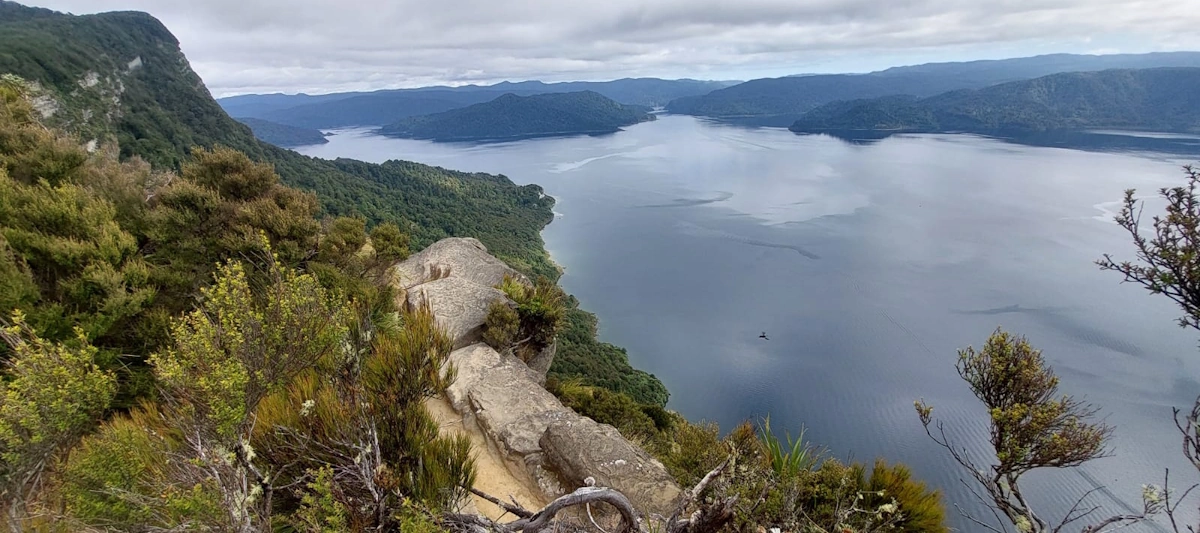
The track wasted no time. From the Onepoto boat landing the trail immediately began its ascent towards Panekire Bluff — a relentless climb that tested lungs and legs alike. The forest was alive with birdsong from time to time (the melodic calls of tūī) As we gained altitude, glimpses of the lake emerged through the trees, each one more breathtaking than the last.
Alam was suffering. He was carrying an 80-litre pack weighing around 15 kg — mine was 9 kg. He had packed for a different kind of trip entirely: fresh potatoes, onions, rice, a kilogram of fruit, a stove, and a gas canister (he even borrowed my own stove and gas canister and, without warning, used it for 30 minutes) to make curry at the huts. When I saw his backpack, the previous night, I asked him why on earth would someone carry an 80-litre backpack on a 2 days and 3 hours trail, he replied he'll be OK. He was OK until we reached Panakire Hut, but after lunch he slowed down considerably. "I am just walking at my own pace." I have heard that phrase before. It is Alam's smoke signal for "I am exhausted." He soldiered on regardless, though it was clear the pack was taking its toll.
"I am just walking at my own pace."
Alam, somewhere on the way to Waiopaua Hut — a familiar signalFinally, after what felt like an eternity, we crested the bluff. The view was simply stunning — the entire expanse of Lake Waikaremoana stretched out before us, a vast, shimmering sapphire surrounded by an unbroken sea of green. X reached Panekire Hut just as we were leaving after lunch; she had made her own way up without us. We walked on to Waiopaua Hut, nestled in a secluded cove right at the lakeshore — a tranquil spot perfect for an evening swim. The water was icy cold but invigorating. As darkness fell, the stars emerged in full force, brilliant and uninterrupted, far from the light pollution of the city. Alam, having finally accepted that the curry project was not going to happen with that pack on his back, quietly distributed some of his food. He gave me a pear.
Day 2: Waiopaua Hut to Waiharuru Hut (via Marauti for lunch)
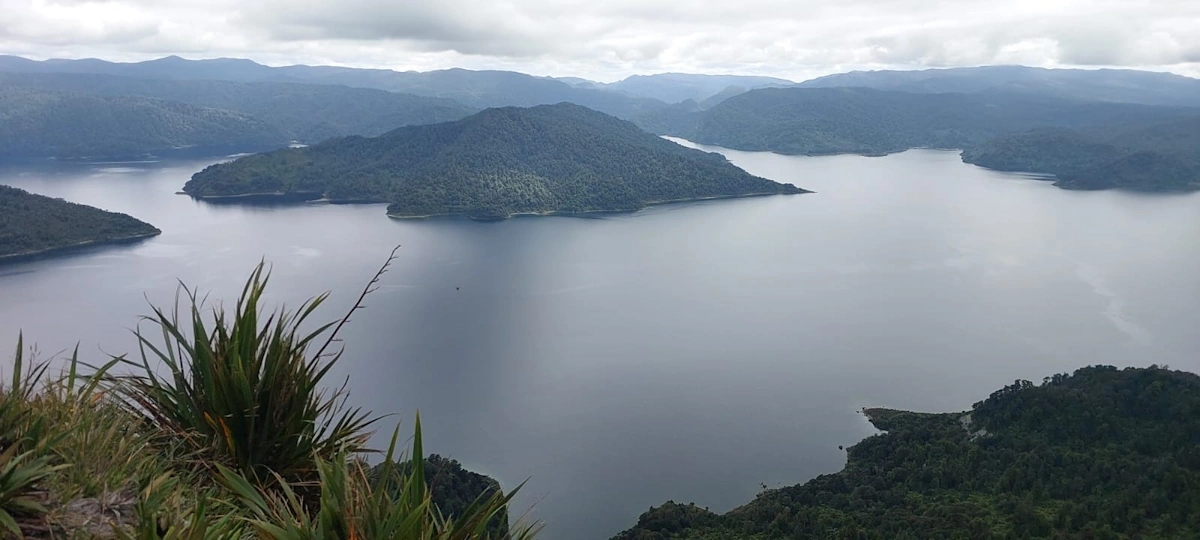
Day 2 was a gentler affair — a welcome reprieve after the climb of the previous day. The track followed the shoreline of the lake for much of the morning, undulating gently through native beech forest, the air thick with the scent of moss and decaying leaves. The forest floor was a tapestry of ferns and fungi. I stopped often to admire the towering trees, their gnarled branches reaching skyward like ancient guardians of this sacred landscape.
We stopped at Marauti Hut for lunch: a small, intimate shelter in a quiet bay, with the lake lapping gently just below. X, who had been walking most of the day with Alam, arrived while we were leaving.
We reached Waiharuru Hut in the afternoon. It was a comfortable base, and the evening was peaceful — the kind of stillness that only a place like Te Urewera can produce. Alam, still carrying what remained of his provisions, had by now accepted that the curry would not happen. The pack had done its damage. "I'll be OK," he said, as he always does.
Day 3: Waiharuru Hut to Onepoto (14.6 km)
The final day was the longest. The track climbed steadily away from the lake before the familiar descent back towards Onepoto. The forest became denser, the air heavier with humidity. Several steep climbs and descents tested stamina and resolve. As we neared the end, the familiar sight of the carpark brought a wave of relief — and a quiet tinge of sadness that the lake, which had been our constant companion for three days, was now behind us.
The Lake Waikaremoana Track is administered by the Department of Conservation and Te Urewera, and it is unlike any other Great Walk in New Zealand. This is not just a trail through beautiful scenery. It passes through land that has profound spiritual and historical significance to Tūhoe — the people of the mist — and that weight is felt with every step.
Epilogue
- On X: She thinks only of herself. The lateness, the tent drama, the stubbornness, the rudeness on the road — it was exhausting before the track even began. I had actually booked a separate cabin just to get away from the negativity the night before. And to make sure I would be staying away from that negativity for life, I banned her from the group as soon as I got connection.
- On Alam: I first met Alam at Cape Reinga last September. He had brought a castle of a tent — so enormous that everyone laughed when they saw it. He had pitched it on a mound near the water. I told him he'd be better off moving closer to the trees. "I'll be OK," he said. During the night the wind ripped the tent away and he slept in his car. "I'm OK," he said, when I came out of my tent in the morning. "I'll buy another one." On Day 2 of Cape Reinga he wanted to go off-track at one point. When I told him it would be much harder, he went anyway. Grace followed him, only for both to turn around later and rejoin us. He knows everything. But he always carried far more than any sensible person would — enough fresh produce to feed a small village. He gave me a pear.
- On the track itself: The Lake Waikaremoana Track is more than a hike. It is an immersion into Te Urewera — one of the wildest, most untouched landscapes in New Zealand. It will challenge you on Day 1 and reward you on every day that follows.
- Will I do it again? Yes — with more people like Orielle and Emily.
Practical Tips
Book your Great Walks pass well in advance through the DOC website — huts fill up fast, especially in peak season. The road to the Waikaremoana Holiday Park is largely gravel (about 80 km), so allow extra travel time and check your vehicle's suitability. If you are driving an EV, plan your charging stops carefully and leave early. Pack for all weather: Te Urewera is known for sudden changes. Wear sturdy, waterproof hiking boots. And take time to learn about the history of this land — it enriches every step.
PACK LIGHT.
BE POSITIVE.