
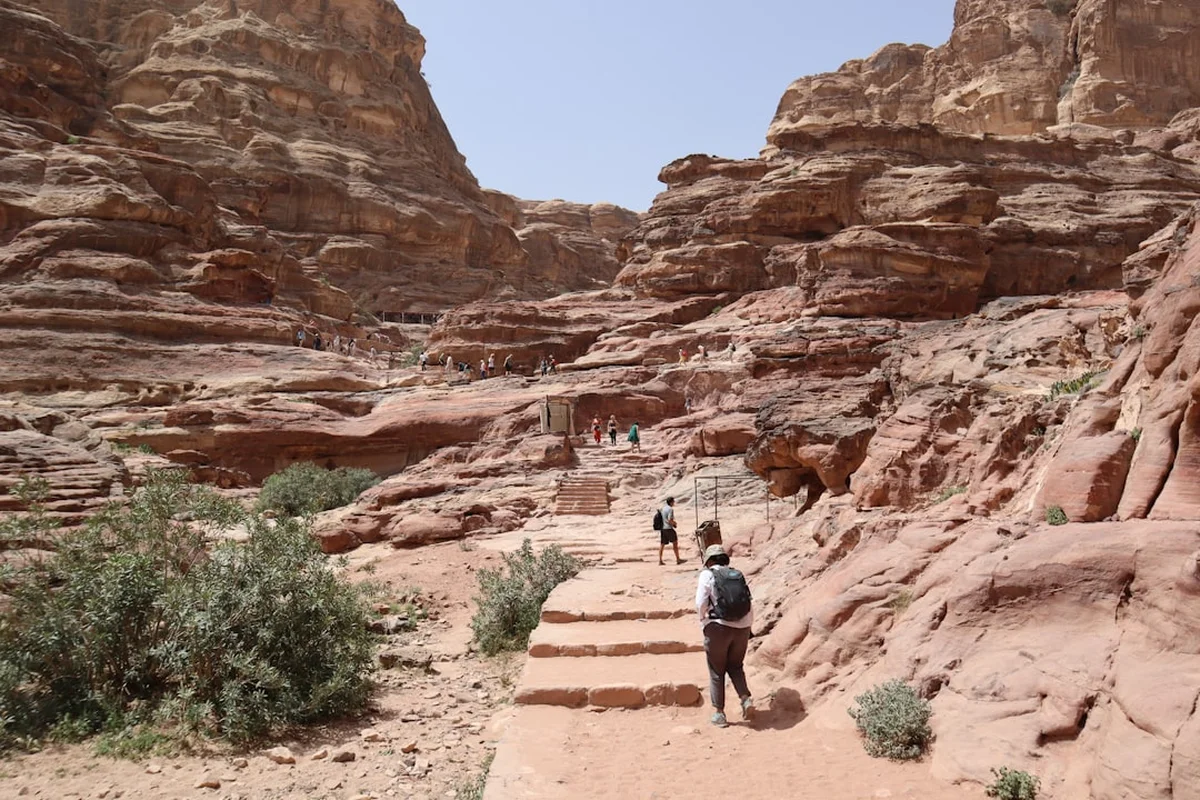
Trek to Petra - The Backdoor to the Rose City
The Trek to Petra, often cited as one of the world's best hikes by National Geographic, is a profound journey through the heart of Jordan’s rugged Levantine landscape. Spanning approximately 80 kilometres, this multi-day expedition traverses the diverse terrain of the Dana Biosphere Reserve, crossing high mountain ridges, expansive desert plateaus, and deep sandstone canyons before culminating at the magnificent "backdoor" entrance to the UNESCO World Heritage site of Petra. Unlike the standard tourist approach through the main Siq, this trek offers a slow-motion immersion into the silence of the desert, the hospitality of the Bedouin people, and the geological wonders of the Rift Valley. It is a journey that connects the ancient stone village of Dana to the rock-cut majesty of the Nabatean capital, providing a historical and physical context that no bus tour can replicate.
- Distance: 80.0 km point-to-point
- Duration: 4–5 days
- Season: March–May and September–November (Spring and Autumn)
- Accommodation: Wild camping, Bedouin camps, and eco-lodges
- Highest point: Jabal Al-Faid (approx. 1,200 m)
- Difficulty: Challenging (requires high fitness and navigation skills)
- Direction: North to South (Dana to Petra)
Overview
The Trek to Petra is the most iconic section of the 675-kilometre Jordan Trail, a long-distance route that spans the length of the country. This specific four-to-five-day segment is celebrated for its dramatic ecological transitions. Walkers begin in the Mediterranean-like climate of the Dana Village, perched on the edge of a precipice, and descend through four distinct bio-geographical zones: Mediterranean, Irano-Turanian, Saharo-Arabian, and Sudanian. Within a single day’s walk, the flora can shift from evergreen oaks and juniper trees to the hardy acacias of the desert floor. The landscape is a masterclass in geology, showcasing Precambrian granite basements topped by layers of vibrant Cambrian and Ordovician sandstone, carved into fantastic shapes by millennia of wind and rare, torrential rain.
The physical challenge of the trek is significant. While the first day is largely a descent, subsequent days involve demanding ascents over mountain passes and long stretches across exposed, sun-baked plateaus. The path is often indistinct, following ancient shepherd tracks and dry wadi beds (river valleys). This is not a manicured trail; it is a wilderness experience that requires a steady foot and a keen eye for the landscape. The reward for this exertion is a profound sense of isolation. For much of the journey, the only other living souls you may encounter are Bedouin herders tending to their goats or camels, often inviting weary travellers for a glass of sweet sage tea over a small brushwood fire.
The climax of the trek is the approach to Petra via the "Backdoor." While most visitors enter the ancient city through the narrow, shaded Siq to see the Treasury, hikers on this route arrive at the Monastery (Ad Deir)—Petra’s largest and most imposing monument—from the high mountains to the north. Emerging from a narrow mountain trail to see the 45-metre-high facade carved into the golden rock is one of the most spectacular reveals in global trekking. This approach allows for a comprehensive understanding of Petra not just as a collection of monuments, but as a strategic mountain stronghold and a hub of ancient global trade.
History and Cultural Context
The path between Dana and Petra follows segments of the ancient Incense Route, a network of trade paths that once connected the Mediterranean world with eastern and southern sources of incense, spices, myrrh, and silk. The Nabateans, a nomadic Arab people who settled in the area over 2,000 years ago, became masters of this desert landscape. They were not only skilled traders but also brilliant hydraulic engineers, developing sophisticated systems of dams, cisterns, and terracotta pipes to harvest every drop of water in an arid environment. Their capital, Petra, was a cosmopolitan centre where Hellenistic architecture blended with Eastern traditions, all carved directly into the living rock.
The Dana Biosphere Reserve, where the trek begins, has its own deep history. The village of Dana has been inhabited since the 15th century, with its stone houses built into the mountainside overlooking the Wadi Dana. In the 1980s, the village was nearly abandoned as residents moved to more modern settlements with better infrastructure. However, a concerted effort by the Royal Society for the Conservation of Nature (RSCN) helped revitalise the village through eco-tourism, making it a model for sustainable development in the Middle East. Walking through Dana today is like stepping back in time, with its terraced gardens and traditional stone masonry preserved against the backdrop of the Great Rift Valley.
Throughout the trek, the presence of the Bedouin people provides a living link to the past. The tribes of the region, such as the Al-Ammarin and the Al-Bedoul, have navigated these mountains for centuries. Their culture is defined by "Diyafa" (hospitality), a code of conduct born from the necessity of survival in the desert. Even today, the Bedouin maintain a deep knowledge of the land, from the medicinal uses of desert plants to the location of hidden springs. Engaging with this culture—whether through a shared meal or a night spent in a goat-hair tent—is as much a part of the Trek to Petra as the physical act of walking.
Want more background? Read extended notes on history and cultural context → Learn more
Seasonal Highlights and Weather Reality
Timing is critical for the Trek to Petra. Jordan’s desert climate is one of extremes, and attempting this walk in the wrong season can be dangerous. The primary windows for trekking are Spring (March to May) and Autumn (September to November).
Spring (March–May): This is arguably the most beautiful time to hike. After the winter rains, the desert undergoes a brief but spectacular transformation. The Dana Biosphere Reserve bursts into colour with wildflowers, including the rare Black Iris (Jordan’s national flower). The temperatures are generally mild, ranging from 15°C to 25°C during the day, though nights can still be crisp. However, spring can also bring the "Khamsin," a hot, dusty wind from the south that can reduce visibility and cause temperatures to spike suddenly.
Autumn (September–November): As the summer heat fades, the trekking season reopens. The air is often clearer than in spring, providing vast views across the Rift Valley toward Israel and Palestine. The landscape is much drier and more "classic desert" in appearance. Temperatures are similar to spring, but the days are shorter, requiring more disciplined pacing to reach camp before sunset.
Winter (December–February): While trekking is possible, it is not recommended for the average walker. The mountains around Dana and Petra can experience snow, and the wadis are prone to sudden, lethal flash floods. Rain in the highlands can turn a dry riverbed into a raging torrent kilometres away in minutes. Temperatures at night frequently drop below freezing.
Summer (June–August): Trekking during the height of summer is strongly discouraged. Temperatures regularly exceed 40°C, and there is virtually no shade on the long plateaus. The risk of heatstroke and severe dehydration is extremely high, and many local guides refuse to lead trips during these months.
Recommended Itinerary
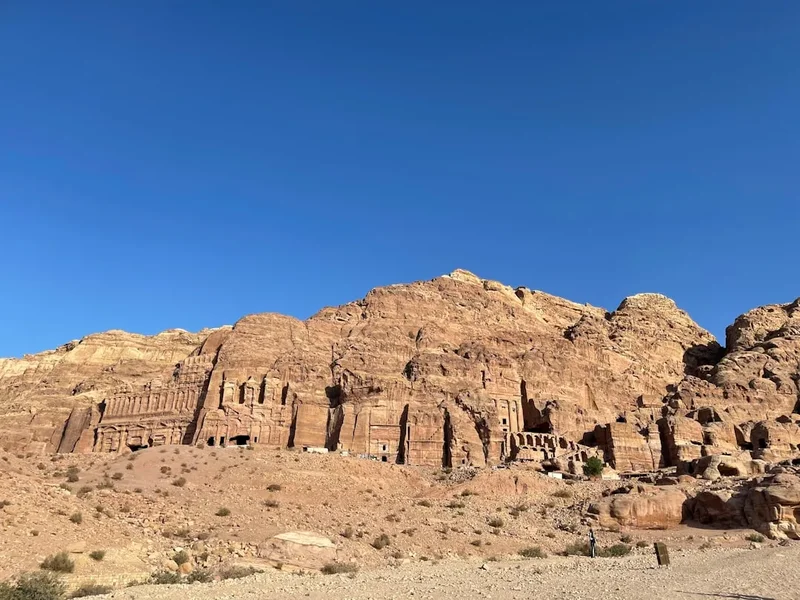
5-Day Trek to Petra Itinerary
Day 1: Dana Village to Wadi Malaga
- Distance: 23.5 km
- Elevation: 250 m gain / 1,200 m loss
- Time: 7–9 hours
- Start at the historic Dana Village (1,200 m)
- Descend through the spectacular Wadi Dana, passing through four bio-geographical zones
- Observe the transition from Mediterranean forest to arid desert floor
- Pass the copper mines of Wadi Feynan, used since the Chalcolithic period
- Continue across the gravel plains of the Araba Valley
- Camp at Wadi Malaga, a scenic spot at the base of the mountains
- This is a long day with a significant descent that can be hard on the knees
Day 2: Wadi Malaga to Ras Al-Faid
- Distance: 13.7 km
- Elevation: 850 m gain / 150 m loss
- Time: 6–8 hours
- A challenging day involving a steep ascent from the desert floor back into the mountains
- Follow ancient Bedouin trails up the "Sharrah" mountains
- Navigate through narrow canyons and over rocky ridges
- Spectacular views back over the Wadi Araba toward the sunset
- Camp at Ras Al-Faid, a high-altitude plateau with reliable (though seasonal) water sources nearby
- The terrain is rugged and requires careful footwork on loose scree
Day 3: Ras Al-Faid to Little Petra (Siq al-Barid)
- Distance: 22.8 km
- Elevation: 600 m gain / 550 m loss
- Time: 8–10 hours
- Cross the high plateaus of Jabal Al-Faid
- Pass through remote Bedouin encampments and ancient agricultural terraces
- The landscape shifts to the white "bulbous" sandstone characteristic of the Petra region
- Arrive at Little Petra (Siq al-Barid), believed to have been a "suburb" or trading post for the main city
- Explore the painted biclinium (dining hall) in Little Petra
- Stay in a fixed Bedouin camp or wild camp nearby
Day 4: Little Petra to Petra (The Monastery)
- Distance: 12.6 km
- Elevation: 450 m gain / 350 m loss
- Time: 4–6 hours
- The "Backdoor" approach to Petra
- Follow a well-defined but narrow mountain trail along the edge of deep canyons
- Ascend the final ridge to reveal the massive facade of the Monastery (Ad Deir)
- Descend the 800 rock-cut steps from the Monastery into the main Petra basin
- Pass the Qasr al-Bint temple and the Colonnaded Street
- Exit via the main Siq and the Treasury (Al-Khazneh)
- Finish in the town of Wadi Musa
Day 5: Exploring Petra and Departure
- Distance: Variable (10–15 km)
- Time: Full day
- Use this day to explore the parts of Petra missed during the trek
- Hike to the High Place of Sacrifice for panoramic views
- Visit the Royal Tombs and the Roman Theatre
- Evening departure to Amman or Aqaba, or stay an extra night in Wadi Musa
Important Notes:
- A local guide is highly recommended due to the lack of trail markings and water sources
- The Jordan Pass should be purchased in advance to cover Petra entry fees
- Water must be treated or carried in large quantities (minimum 3–4 litres per day)
- The trail involves significant exposure to the sun; protective clothing is essential
- Respect local customs by dressing modestly, especially when passing through villages
Planning and Bookings
Book Your Trip
Everything you need to plan your journey
Accommodation
Find places to stay near Wadi Musa
Flights
Search flights to Wadi Musa
Essential Preparation
The Trek to Petra is a serious undertaking that requires physical and logistical preparation. Walkers should be in good cardiovascular health and comfortable walking 20+ kilometres a day on uneven, rocky terrain. Training should include hill climbs and walking with a weighted pack. Logistically, the trek is best organised from Amman or Wadi Musa. Most hikers take a JETT bus or private taxi from Amman to Wadi Musa, and then arrange a transfer to the starting point in Dana Village. It is essential to coordinate your arrival in Dana with your accommodation or guide. Because the trail is remote, many hikers choose to hire a local guide through the Jordan Trail Association or a reputable tour operator. A guide not only assists with navigation but also organises logistics like water drops, food, and camping equipment, which are difficult to manage independently.
Trail Accommodation
Accommodation on the Trek to Petra ranges from eco-lodges to wild camping under the stars. There are no formal mountain huts like those found in the Alps or New Zealand.
Accommodation Options:
- Dana Village: Several traditional guesthouses and the RSCN-run Dana Guest House offer comfortable rooms and spectacular views.
- Feynan Ecolodge: Located at the end of Day 1, this award-winning lodge is off-grid and candle-lit, providing a luxury eco-experience.
- Bedouin Camps: Near Little Petra and Wadi Musa, fixed camps offer goat-hair tents with beds, communal dining areas, and basic bathroom facilities.
- Wild Camping: For the middle sections (Wadi Malaga and Ras Al-Faid), wild camping is the only option. You must bring your own tent, sleeping bag, and mat.
Facilities Provided:
- Fixed camps usually provide dinner, breakfast, and basic bedding.
- Eco-lodges provide full amenities but often at a higher price point.
- Wild camping sites have zero facilities—no toilets, no running water, and no shelter.
What's NOT Provided:
- Electricity for charging devices (except in lodges/towns).
- Mobile signal (very spotty throughout the trek).
- Bedding or tents for the wild camping sections.
- Water at wild campsites (must be carried or arranged via water drops).
Required Gear
- Hiking boots: Sturdy, high-cut boots with good grip are essential for the rocky and loose terrain.
- Backpack: 50–65L if carrying your own gear; 25–35L if using a support vehicle for luggage.
- Sun protection: Wide-brimmed hat, high-SPF sunscreen, and UV-rated sunglasses.
- Clothing: Lightweight, breathable long-sleeved shirts and trousers to protect from sun and thorns. A warm fleece or down jacket for cold desert nights.
- Navigation: GPS device with pre-loaded tracks, paper maps, and a compass.
- Headlamp: With spare batteries for camp use and early starts.
- First aid kit: Including blister pads (Compeed), rehydration salts, and any personal medications.
What to Bring
- Water storage: Capacity for at least 4 litres (e.g., two 2L bladders or bottles).
- Water treatment: Portable filter (Sawyer Squeeze or Katadyn) or purification tablets.
- Food: High-energy snacks (dates, nuts, energy bars) and lightweight dehydrated meals if not using a guided service.
- Toiletries: Biodegradable soap, wet wipes (for "desert showers"), and a trowel for waste disposal.
- Power bank: To keep GPS and phone charged in remote areas.
- Trekking poles: Highly recommended for the steep descents and ascents.
- Jordan Pass: Printed copy for entry to Petra and other sites.
Permits
There is no specific "trekking permit" required to walk the Jordan Trail or the Trek to Petra. However, you must pay entry fees for the protected areas you pass through and for the final destination of Petra itself.
Jordan Pass: The most cost-effective way to handle permits is to purchase the Jordan Pass before arrival. This pass waives the visa entry fee (if staying at least three nights) and includes entry to over 40 attractions, including Petra.
- Jordan Wanderer (1-day Petra): 70 JOD
- Jordan Explorer (2-day Petra): 75 JOD
- Jordan Expert (3-day Petra): 80 JOD
Dana Biosphere Reserve Fee: There is a small entrance fee for the Dana Biosphere Reserve (approx. 7–10 JOD), which supports the conservation efforts of the RSCN. This is usually paid at the Dana Guest House or included in your lodge booking.
Petra Entry: If you do not have a Jordan Pass, a standard 1-day ticket to Petra costs 50 JOD. Note that you must enter through the main gate in Wadi Musa to "activate" your ticket before you can legally enter through the "Backdoor" from Little Petra. If you are trekking with a licensed guide, they can often facilitate this process or ensure you have the correct documentation to enter from the north.
Other Activities in the Area
Jordan is a compact country with a wealth of historical and natural sites. Consider these additions to your itinerary:
- Wadi Rum: A two-hour drive south of Petra, this "Valley of the Moon" offers world-class rock climbing, jeep tours, and overnight stays in luxury Martian-style domes.
- The Dead Sea: The lowest point on Earth. Floating in the hypersaline waters is the perfect way to soothe sore muscles after an 80-kilometre trek.
- Aqaba and the Red Sea: For those seeking relaxation, Aqaba offers excellent snorkelling and diving on the northernmost coral reefs in the world.
- Mount Nebo and Madaba: Visit the site where Moses is said to have seen the Promised Land and view the famous 6th-century mosaic map of the Holy Land in Madaba.
- Wadi Mujib: Known as the "Grand Canyon of Jordan," this spectacular river canyon offers seasonal wet-hiking and canyoning adventures.
Safety and Conditions
Heat and Hydration: The single greatest risk on the Trek to Petra is heat exhaustion and dehydration. There is very little shade, and the sun is intense. You must drink consistently, even if you do not feel thirsty. Adding electrolytes to your water is essential to replace salts lost through sweat. Aim to start your walking days as early as possible (at sunrise) to complete the bulk of the distance before the midday heat.
Flash Floods: While Jordan is an arid country, winter and early spring can bring sudden, violent rainstorms. These storms can cause flash floods in the wadis. If the sky looks dark upstream or if rain is forecast, avoid camping or walking in narrow canyon floors. Always seek high ground if you hear a distant roaring sound.
Navigation: The trail is not marked with consistent signage. It is very easy to take a wrong turn into a side wadi or follow a goat track that leads to a cliff edge. Using a GPS with a reliable topo map is mandatory for independent hikers. If you are not experienced in desert navigation, hiring a local Bedouin guide is the safest and most rewarding option.
Wildlife: While rare, scorpions and vipers (such as the Arabian Horned Viper) exist in the desert. Always shake out your boots in the morning and avoid sticking your hands into dark rock crevices. Most desert animals are nocturnal and will avoid humans if given the chance.
Emergency Services: Mobile phone coverage is non-existent in the deep canyons. If trekking independently, carrying a satellite messenger (like a Garmin inReach) is highly recommended. In case of emergency, the Jordan Trail Association and local police can coordinate rescues, but response times can be long due to the remote terrain.
Side Trips and Points of Interest
The Monastery (Ad Deir): While this is the "finish line" of the trek, it deserves significant time. Carved in the mid-1st century AD, it is larger than the famous Treasury. The courtyard in front of it offers a perfect place to rest, and several nearby viewpoints provide vistas all the way to the Wadi Araba.
Little Petra (Siq al-Barid): Often overlooked by tourists, this site contains some of the only surviving Nabatean wall paintings. The "Painted House" features intricate frescoes of birds, grapes, and flowers, giving a rare glimpse into the interior aesthetics of the Nabateans.
Feynan Copper Mines: On Day 1, you will pass through an area littered with black slag. These are the remains of ancient copper smelting operations. The mines here were some of the largest in the Roman Empire, and the scale of the industrial waste is a testament to the region's ancient economic importance.
Jabal Haroun (Aaron’s Tomb): A significant detour from the main trail near Petra leads to the white-domed mosque atop Jordan’s highest peak in the area. It is believed to be the burial place of Aaron, the brother of Moses. The climb is strenuous but offers the most comprehensive view of the entire Petra archaeological park.
Leave No Trace
The desert ecosystem is surprisingly fragile. Footprints and tyre tracks can remain visible for years, and the lack of moisture means that organic waste decomposes very slowly. As the Trek to Petra grows in popularity, it is vital that every hiker adheres to strict Leave No Trace principles to preserve the wilderness for the Bedouin communities and future trekkers.
Desert Ethics:
- Waste Disposal: Pack out all trash, including "biodegradable" items like orange peels and tea bags. For human waste, dig a "cathole" at least 20 cm deep and at least 60 metres from any dry wadi bed or water source. Pack out all used toilet paper in a sealed bag.
- Water Sources: Desert springs (bir) are life-giving for local wildlife and livestock. Never wash yourself or your dishes directly in a spring. Collect water in a container and move at least 30 metres away to wash.
- Archaeological Integrity: Do not move stones, pick up pottery shards, or touch ancient wall paintings. These are irreplaceable historical records.
- Fire: Wood is extremely scarce in the desert. If you must have a fire, use only small amounts of dead, downed wood and keep the fire small. Better yet, use a lightweight camping stove for cooking.
- Respect Wildlife: Observe animals from a distance. Do not feed the local dogs or donkeys, as this encourages aggressive behaviour toward future hikers.