
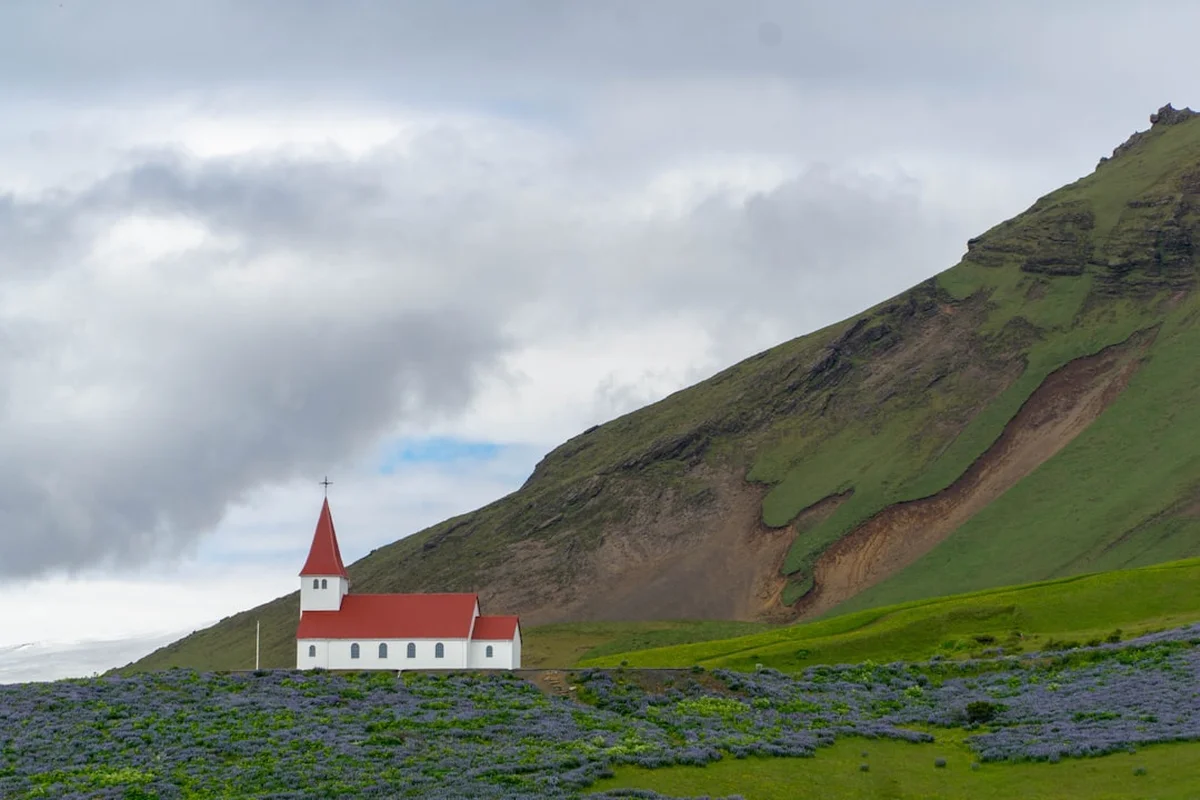
Laugavegur & Fimmvörðuháls Trek - Iceland's Volcanic Odyssey
The Laugavegur and Fimmvörðuháls Trek is widely considered one of the most spectacular wilderness journeys on Earth. Spanning 82 kilometres through the heart of Iceland’s southern highlands, this route connects the geothermal wonderland of Landmannalaugar to the lush coastal forest of Þórsmörk, before ascending over the dramatic mountain pass of Fimmvörðuháls to finish at the iconic Skógafoss waterfall. This is a landscape of impossible contrasts: neon-green moss set against pitch-black volcanic sands, steaming geothermal vents adjacent to ancient blue glaciers, and multicoloured rhyolite mountains that look more like a painting than a geological reality. The trek is a journey through the very forces that continue to shape our planet, traversing terrain so otherworldly that it has long served as a training ground for astronauts and a backdrop for epic sagas.
- Distance: 82.0 km total (55 km Laugavegur + 27 km Fimmvörðuháls)
- Duration: 6–8 days
- Season: Late June to late September (dependent on snowmelt and road openings)
- Huts: Landmannalaugar, Hrafntinnusker, Álftavatn, Hvanngil, Emstrur, Þórsmörk, Fimmvörðuháls, Baldvinsskáli
- Highest point: Fimmvörðuháls Pass (1,116 m) and Hrafntinnusker (1,100 m)
- Difficulty: Challenging (requires river crossings, alpine navigation, and endurance)
- Direction: Typically walked North to South (Landmannalaugar to Skógar)
Overview
The Laugavegur and Fimmvörðuháls Trek is not merely a hike; it is a traverse of a living, breathing geological masterpiece. The route is traditionally divided into two distinct sections. The first, the Laugavegur (meaning "The Hot Spring Route"), covers 55 kilometres from Landmannalaugar to the valley of Þórsmörk. The second, the Fimmvörðuháls, adds a further 27 kilometres, climbing between two massive glaciers—Eyjafjallajökull and Mýrdalsjökull—before descending the "Waterfall Way" to the Atlantic coast. Together, they form a continuous line through the most diverse scenery Iceland has to offer.
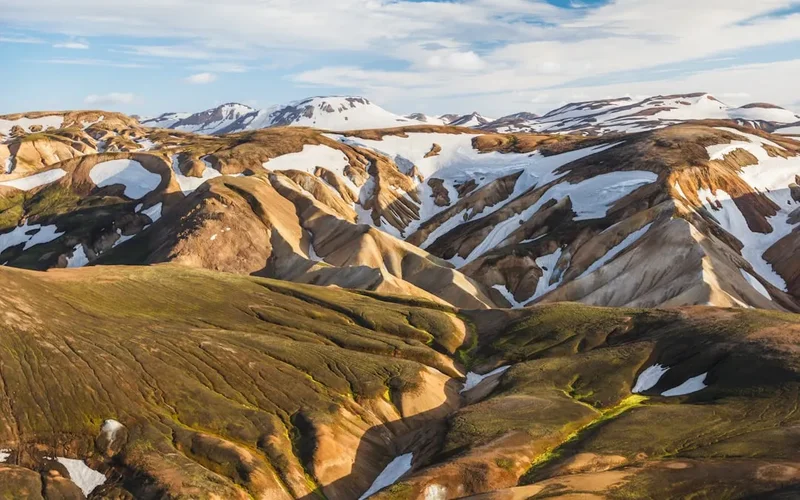
The journey begins in Landmannalaugar, a geothermal hub where the mountains are composed of rhyolite, a volcanic rock that creates shades of ochre, pink, yellow, and blue. As you move south, the landscape shifts dramatically into the obsidian fields of Hrafntinnusker, where shards of black volcanic glass litter the trail. From there, the path drops into the verdant, lake-filled basin of Álftavatn, providing a sharp contrast to the high-alpine desolation of the first day. The middle section of the trek crosses the Mælifellssandur, a vast black sand desert where the scale of the Icelandic interior becomes truly apparent. Here, the only splashes of colour are the vibrant green "hats" of moss-covered volcanic cones rising from the dark plains.
The transition into Þórsmörk (Thor’s Forest) marks a shift into a sub-arctic woodland of twisted birch and deep canyons. For many, this is the end of the journey, but for those continuing over Fimmvörðuháls, the greatest challenge lies ahead. This final section involves a steep ascent into the "Pass of the Five Cairns," crossing the very site of the 2010 Eyjafjallajökull eruption. Walkers pass between two brand-new volcanic craters, Magni and Móði, where the ground remains warm to the touch. The final descent follows the Skógá River, passing no fewer than 26 significant waterfalls before reaching the 60-metre drop of Skógafoss. This trek demands respect for the elements, as weather in the highlands is notoriously fickle, but for those who prepare, it offers a profound connection to the raw power of nature.
History and Cultural Context
The history of the Laugavegur trail is inextricably linked to the Icelandic spirit of exploration and the necessity of travel through the rugged interior. For centuries, the highlands were considered the domain of outlaws, spirits, and "hidden people" (huldufólk). Landmannalaugar itself has been used since the Middle Ages as a seasonal grazing area for sheep, with farmers driving their flocks into the mountains each summer. The name Landmannalaugar translates to "The People's Pools," referring to the natural geothermal springs that have provided weary travellers with warmth and respite for over a millennium.
The modern trail was formalised by the Ferðafélag Íslands (Icelandic Touring Association), founded in 1927. The association built the first huts along the route to encourage Icelanders to explore their own wilderness. The Laugavegur quickly became the country's most famous hiking route, symbolising the national love for the outdoors. The Fimmvörðuháls section has its own storied history, traditionally used as a mountain pass connecting the farms of the south coast to the inland valleys. It gained international fame in 2010 when a flank eruption of the Eyjafjallajökull volcano occurred directly on the trail, creating two new mountains and a massive lava field that hikers now walk across.
Culturally, the trail is steeped in Icelandic folklore. Every peak and valley has a name and often a story attached to it. The valley of Þórsmörk is named after the Norse god Thor, who is said to have struck the earth with his hammer to create the dramatic landscape. Walking this route is as much a journey through Icelandic mythology as it is through its geology. The preservation of this trail is a point of national pride, and the balance between its increasing popularity and the protection of its fragile ecosystem remains a central theme in its modern management.
Want more background? Read extended notes on history and cultural context → Learn more
Seasonal Highlights and Weather Reality
The window for trekking the Laugavegur and Fimmvörðuháls is remarkably short, typically lasting from late June to mid-September. Outside of this period, the highland roads (F-roads) are closed to all traffic, and the trail is buried under deep snow, making it the exclusive domain of experienced winter mountaineers. Even during the peak summer months, the weather is the primary factor in any trekker's success or failure.
Late June to July: This is the time of the "Midnight Sun," where 24-hour daylight allows for maximum flexibility in walking hours. However, early season hikers must contend with significant snow patches, particularly on the high plateau of Hrafntinnusker. River levels are often at their highest during this period due to snowmelt, making crossings more challenging. The rhyolite mountains are at their most vibrant, often still streaked with white snow, creating a stunning visual contrast.
August: Generally considered the most stable month for weather, though "stable" in Iceland is a relative term. The snow has mostly melted from the trail, and the moss is at its most brilliant green. This is also the busiest time on the trail, requiring hut bookings to be made many months in advance. The berries in Þórsmörk begin to ripen, and the nights start to darken, occasionally offering the first glimpses of the Northern Lights toward the end of the month.
September: The crowds thin out, and the autumn colours (haustlitir) transform the birch forests of Þórsmörk into a sea of gold and red. The weather becomes more unpredictable, with a higher frequency of Atlantic storms bringing heavy rain and high winds. By mid-September, the first winter snows often begin to fall on the higher passes, and the mountain huts begin to close for the season. This is a beautiful but high-risk time to trek.
Weather Reality: It is common to experience four seasons in a single day. Horizontal rain, dense fog that reduces visibility to five metres, and gale-force winds are all possible even in July. Hypothermia is a genuine risk for those without proper waterproof gear. Always check the forecast daily at the huts or via the Safetravel app.
Recommended Itinerary
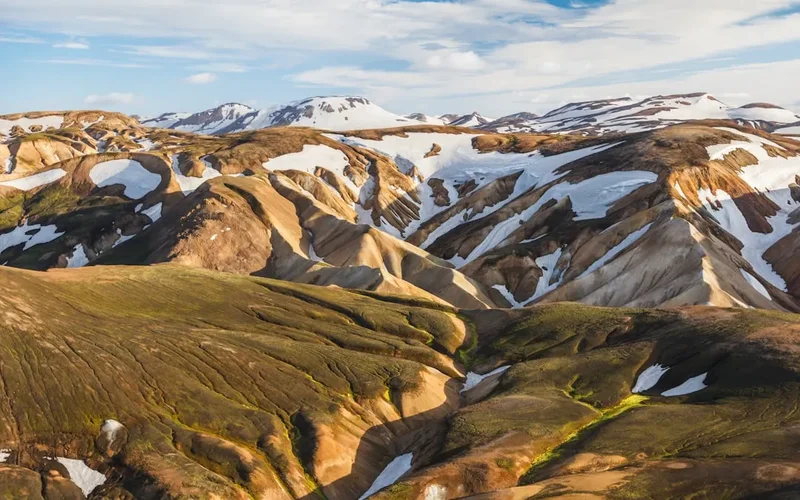
6-Day Laugavegur & Fimmvörðuháls Itinerary
Day 1: Landmannalaugar to Hrafntinnusker
- Distance: 12 km
- Elevation gain: 470 m
- Time: 4–5 hours
- Start at the Landmannalaugar hut and geothermal area
- Climb through the Laugahraun lava field toward the colourful Brennisteinsalda peak
- Enter the high-alpine zone with numerous steaming vents and sulphur pits
- Traverse the obsidian fields where the trail is marked by black volcanic glass
- Arrive at Hrafntinnusker Hut (Höskuldsskáli), the highest and most exposed hut on the trail
- Note: This section often has snow even in mid-summer; navigation in fog is critical here
Day 2: Hrafntinnusker to Álftavatn
- Distance: 12 km
- Elevation loss: 490 m
- Time: 4–5 hours
- Cross the Reykjafjöll mountains with views of the glaciers to the south
- Descend the steep Jökultungur slope, where the landscape changes from volcanic desert to green valleys
- First major view of Lake Álftavatn and the surrounding green peaks
- Cross the first unbridged river (Grashagakvísl) before reaching the hut
- Arrive at Álftavatn Hut, situated on the shores of a beautiful alpine lake
Day 3: Álftavatn to Emstrur (Botnar)
- Distance: 15 km
- Elevation loss: 40 m (mostly flat with rolling hills)
- Time: 6–7 hours
- Pass the green volcanic cone of Stóra-Súla
- Enter the Mælifellssandur black sand desert
- Cross the Bratthálskvísl river (requires wading)
- Walk through a vast, desolate landscape of volcanic ash and grit
- Cross the bridge over the powerful Nyrðri-Emstruá river canyon
- Arrive at Emstrur (Botnar) Hut, tucked away in a small green oasis amidst the desert
Day 4: Emstrur to Þórsmörk
- Distance: 15 km
- Elevation loss: 300 m
- Time: 6–7 hours
- Descend into the canyons of the Syðri-Emstruá river
- Walk along the base of the Almenningar hills
- The first sightings of birch trees as you approach the Þórsmörk valley
- Cross the final bridge over the Ljósá river
- Arrive at Þórsmörk (Langidalur or Húsadalur huts)
- Celebrate the completion of the Laugavegur section in the lush forest
Day 5: Þórsmörk to Fimmvörðuháls
- Distance: 12–14 km
- Elevation gain: 900 m
- Time: 6–7 hours
- Steep climb out of Þórsmörk via the "Cat's Spine" (Köttur) ridge
- Ascend onto the Morinsheiði plateau with views of the glaciers
- Cross the "Bridge over the Abyss" (Heljarkambur), a narrow ridge between two canyons
- Walk across the 2010 lava fields and between the new craters Magni and Móði
- Arrive at Fimmvörðuháls Hut or Baldvinsskáli Hut for the night
- Note: This is the most weather-dependent section of the entire trek
Day 6: Fimmvörðuháls to Skógar
- Distance: 14 km
- Elevation loss: 1,000 m
- Time: 5–6 hours
- Follow the Skógá River downstream
- Pass 26 distinct waterfalls of varying sizes and shapes
- The trail is mostly downhill on a well-defined path
- Final dramatic descent alongside the massive Skógafoss waterfall
- Finish at the Skógar car park for bus transport back to Reykjavik
Important Notes:
- Huts must be booked 6–9 months in advance via Ferðafélag Íslands
- River crossings require sandals or neoprene boots; never cross barefoot
- The Fimmvörðuháls section can be done as a long day hike (10–12 hours) if not staying overnight
- Drinking water is available at all huts and from most clear-running streams
- Mobile signal is intermittent; a GPS device with offline maps is essential
Planning and Bookings
Book Your Trip
Everything you need to plan your journey
Accommodation
Find places to stay near Reykjavik
Essential Preparation
The Laugavegur and Fimmvörðuháls Trek requires significant logistical planning. Unlike many European trails, there are no villages or shops along the route. You must carry all your food for the duration of the trek. Fitness is paramount; while the daily distances are moderate, the terrain is rugged, and carrying a full multi-day pack (typically 12–18 kg) over steep passes and through soft sand is physically demanding. You should be comfortable walking 6–8 hours a day for several consecutive days.
Reykjavik serves as the primary base for all trekkers. Most hikers spend a night in the capital before taking a "Highland Bus" to Landmannalaugar. These specialised 4x4 buses are the only reliable way to reach the trailhead, as they are designed to ford deep rivers. Companies like Reykjavik Excursions and Trex operate daily services during the summer. If you plan to drive yourself, you must have a 4x4 vehicle and be experienced in river crossings; however, most trekkers prefer the bus to avoid the logistical headache of a one-way hike.
Trail Accommodation
Accommodation on the trail consists of mountain huts and designated campsites. The huts are managed by Ferðafélag Íslands (FI) and Útivist. They are basic but provide essential shelter from the harsh Icelandic elements.
Hut Facilities:
- Dormitory-style bunk beds with mattresses (sleeping bags are mandatory)
- Shared kitchen facilities with gas stoves and basic cookware (pots, pans)
- Common dining areas
- Flush toilets (at most huts) and outdoor sinks
- Showers are available at most huts (except Hrafntinnusker) for a fee (approx. 500 ISK for 5 minutes)
- Wardens are stationed at every hut to provide weather updates and trail advice
What Huts Don't Provide:
- Food or snacks (except for very limited supplies at Álftavatn and Þórsmörk)
- Bedding, pillows, or towels
- Electricity for charging devices (some huts have limited solar charging for a fee, but it is unreliable)
- WiFi or reliable mobile signal
Booking Requirements:
- Hut bookings open in late autumn for the following summer and sell out almost instantly
- Camping does not require pre-booking but is only permitted in designated areas next to the huts
- Camping costs approximately 2,500 ISK per person, per night, and includes access to toilets but not the hut kitchens
Required Gear
- Hiking boots - high-cut, waterproof, and thoroughly broken in
- Waterproof jacket and trousers - must be high-quality hardshell (Gore-Tex or similar) to withstand horizontal rain
- River crossing shoes - sturdy sandals (Tevas/Chacos) or neoprene booties with a grip sole
- Backpack - 50–65 litres with a high-quality rain cover and internal waterproof liners (dry bags)
- Sleeping bag - 3-season rated (comfort level down to 0°C or -5°C)
- Navigation - GPS device, compass, and physical waterproof map
- First aid kit - including plenty of blister plasters (Compeed), sports tape, and any personal medications
- Power bank - high capacity (20,000mAh+) as there is no charging on the trail
What to Bring
- Food - lightweight, high-calorie dehydrated meals, porridge, nuts, chocolate, and energy bars
- Water bottle - 1–2 litre capacity (water in Iceland is pristine; no treatment is usually necessary for stream water)
- Clothing layers - merino wool base layers (never cotton), fleece or down mid-layer, warm hat, and waterproof gloves
- Sun protection - sunglasses and sunscreen (the Arctic sun is surprisingly strong, especially on snow)
- Toiletries - biodegradable soap, quick-dry towel, and hand sanitiser
- Trekking poles - highly recommended for stability during river crossings and steep descents
- Earplugs and eye mask - essential for sleeping in crowded dormitories during the 24-hour daylight
Permits
There is no "permit" required to walk the Laugavegur or Fimmvörðuháls in the traditional sense. Access to the national parks and the trail itself is free. However, the "permit" in practice is your hut booking. Because wild camping is strictly prohibited within the Fjallabak Nature Reserve and the national parks, you must stay at the designated hut sites.
Booking Strategy:
- Monitor the Ferðafélag Íslands (FI) website starting in October for the following year's opening dates
- If huts are full, consider a guided tour, as tour operators often have pre-reserved blocks of beds
- Camping is the only flexible option; if you cannot secure hut bookings, you must be prepared with a high-quality 4-season tent capable of withstanding 100 km/h winds
- For the Fimmvörðuháls section, there are two huts: the FI hut (Fimmvörðuháli) and the Baldvinsskáli hut. Both are small and require early booking
Costs:
- Hut stay: Approximately 10,000–13,000 ISK per night
- Camping: Approximately 2,500 ISK per night
- Bus transport: Approximately 15,000–20,000 ISK for a round-trip "Hiking Pass"
Environmental Regulations: While no paper permit is issued, hikers are legally required to stay on marked trails. The volcanic soil and moss are extremely fragile; a single footprint off-trail can cause erosion that lasts for decades. Wardens have the authority to fine hikers who violate these rules.
Other Activities in the Area
Iceland’s South Coast and Highlands offer numerous ways to extend your adventure:
- Landmannalaugar Hot Springs: Before starting your trek, soak in the natural geothermal river right next to the campsite. It is the perfect way to relax your muscles.
- Skógafoss and Seljalandsfoss: These iconic waterfalls are located at the end of the trek. Seljalandsfoss allows you to walk behind the curtain of water, while Skógafoss offers a powerful mist-filled experience.
- Glacier Hiking: From Þórsmörk or Skógar, you can join guided tours onto the Sólheimajökull or Mýrdalsjökull glaciers to see crevasses and ice sculptures.
- Super Jeep Tours: If you have extra time in Þórsmörk, take a Super Jeep tour into the deeper recesses of the valley to see the Gígjökull glacier tongue, which was partially destroyed in the 2010 eruption.
- The Golden Circle: Most trekkers combine their hike with a visit to Þingvellir National Park, Geysir, and Gullfoss waterfall, which can be done as a day trip from Reykjavik.
Safety and Conditions
River Crossings: This is the most dangerous aspect of the trek. Glacial rivers can change depth and speed within hours. Always cross at the widest point (where the water is shallowest), unbuckle your backpack's waist strap so you can jettison it if you fall, and face upstream while leaning into the current. If the water is above your knees, do not cross alone; wait for others or wait for the water level to drop (usually in the early morning).
Weather and Navigation: The section between Landmannalaugar and Álftavatn is notorious for sudden, dense fog. The trail is marked with wooden stakes, but in whiteout conditions, these can be impossible to see. A GPS with the route pre-loaded is a mandatory safety item. If the weather turns violent, stay at the nearest hut; do not attempt to "push through" a highland storm.
Hypothermia: Even in July, temperatures can hover near 0°C. Combined with wind and rain, hypothermia can set in quickly. Wear wool or synthetic layers—never cotton, which loses all insulating properties when wet. Always keep a set of dry clothes in a waterproof bag at the bottom of your pack.
Emergency Services: Dial 112 for emergencies. However, response times in the highlands can be long. It is highly recommended to log your travel plan on Safetravel.is so that authorities know your expected location and finish date.
Side Trips and Points of Interest
Bláhnúkur (Blue Peak): A 2-hour round trip from Landmannalaugar. This peak offers the best 360-degree view of the rhyolite mountains. The trail is steep but the sight of the multicoloured ridges from above is unparalleled.
Brennisteinsalda (Sulphur Wave): Often visited on Day 1, this is arguably the most colourful mountain in Iceland. It features steaming vents at its base and vibrant streaks of red, green, and yellow rock.
Markarfljótsgljúfur Canyon: A short detour from the Emstrur hut leads to the edge of this 200-metre-deep canyon. The sheer walls and the glacial river below provide a staggering sense of scale.
Magni and Móði Craters: Located on the Fimmvörðuháls pass, these two craters were formed in 2010. The lava here is still cooling, and in some places, you can see steam rising from the rocks. It is one of the few places on Earth where you can walk on such "young" land.
Valahnúkur: A short, steep hike from the Þórsmörk huts that offers a panoramic view of the three glaciers (Eyjafjallajökull, Mýrdalsjökull, and Tindfjallajökull) and the braided river systems of the valley floor.
Leave No Trace
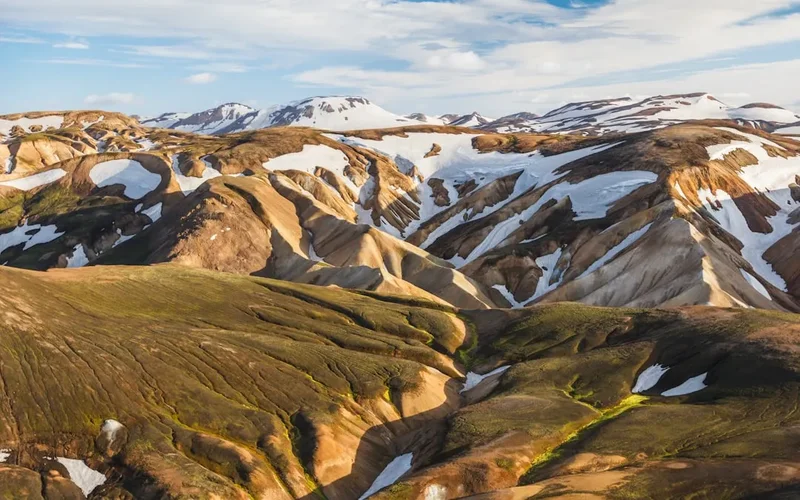
Iceland’s wilderness is exceptionally fragile. The combination of volcanic ash and slow-growing moss means that human impact can remain visible for a lifetime. As a trekker, you are a guest in this delicate ecosystem.
Core Principles:
- Stay on the path: Braiding trails (walking beside the path to avoid mud) destroys the vegetation and causes permanent scarring. Walk through the mud, not around it.
- Pack it out: There are no bins between huts. Every piece of litter, including fruit peels and tea bags, must be carried to the next hut.
- Human waste: Use the toilets at the huts. If you are caught between huts, bury waste in a hole 15–20 cm deep and at least 50 metres from water. Pack out your toilet paper in a sealed bag.
- Respect the moss: Icelandic moss can take 100 years to recover from being stepped on. Never camp on moss; only use the gravelled areas designated for tents.
- No drones: Drones are increasingly restricted in Icelandic national parks to protect the nesting birds and the silence of the wilderness.