

Kumano Kodo (Nakahechi) - The Imperial Path of Enlightenment
The Kumano Kodo is not merely a hiking trail; it is a 1,000-year-old pilgrimage route that weaves through the mist-shrouded Kii Mountains of Japan's Wakayama Prefecture. As one of only two pilgrimage routes in the world designated as a UNESCO World Heritage site (the other being the Camino de Santiago in Spain), the Nakahechi route serves as the spiritual backbone of the Kii Peninsula. Stretching approximately 70 kilometres from the coastal town of Tanabe to the grand shrines of the interior, this "Imperial Route" was historically reserved for emperors, aristocrats, and samurai seeking purification and spiritual rebirth. Today, it offers modern travellers a profound journey through ancient cedar forests, past moss-covered stone statues (Jizo), and into the heart of Japan’s indigenous Shinto and Buddhist traditions. The trail is a physical manifestation of "Shinbutsu-shūgō"—the unique syncretism of Shintoism and Buddhism—where every waterfall, ancient tree, and jagged rock is believed to house a resident deity.
- Distance: 70.0 km (main Nakahechi route)
- Duration: 5–7 days
- Difficulty: Moderate (significant elevation changes and stone staircases)
- Total Elevation Gain: 2,500 m
- Best Time: Spring (April–May) for cherry blossoms and Autumn (October–November) for vibrant maples
- Closest City: Tanabe (Kii-Tanabe Station)
- Trailhead: Takijiri-oji (accessible by bus from Kii-Tanabe)
- Key Landmarks: Kumano Hongu Taisha, Kumano Hayatama Taisha, Kumano Nachi Taisha, and Nachi Falls
Overview
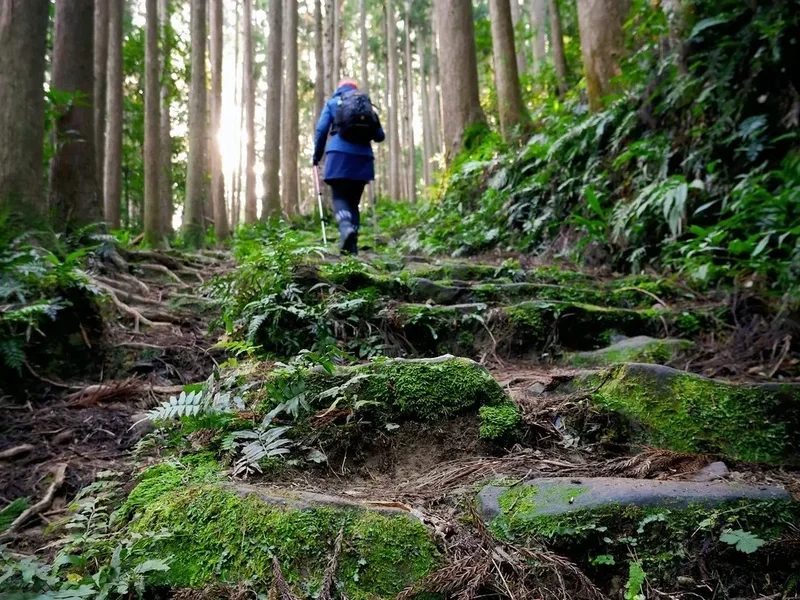
The Nakahechi route of the Kumano Kodo is the most popular and accessible section of the vast pilgrimage network. It is characterised by its well-preserved "ishidatami" (stone-paved) paths that have withstood centuries of typhoons and foot traffic. The journey begins at Takijiri-oji, considered the threshold to the sacred realm of the Kumano Sanzan (the Three Grand Shrines). From here, the trail climbs steeply into the mountains, undulating through dense forests of Japanese cedar (Sugi) and cypress (Hinoki). The landscape is a tapestry of deep emerald valleys, hidden mountain hamlets, and ridge-line vistas that reveal the "1,000 peaks of Kumano."
Walking the Nakahechi is an exercise in cultural immersion. Unlike many wilderness treks, the Kumano Kodo is punctuated by "Oji" shrines—subsidiary shrines of the Kumano deities that serve as both places of worship and navigational waypoints. There were traditionally 99 Oji along the route, and while many are now simple stone foundations or small wooden structures, they remain vital spiritual markers. The physical challenge of the trail is balanced by the hospitality of local "minshuku" (family-run guesthouses) and "ryokan" (traditional inns), where weary pilgrims can soak in natural "onsen" (hot springs) and feast on "kaiseki" (multi-course) meals prepared with mountain vegetables, river fish, and local plum (ume) products.
The route culminates in the spectacular Kumano Sanzan. The first is Kumano Hongu Taisha, with its austere wooden architecture and the massive Otorii gate at Oyunohara. The journey then continues toward the coast to Kumano Hayatama Taisha and finally Kumano Nachi Taisha, which sits adjacent to the 133-metre Nachi Falls—the tallest permanent waterfall in Japan. For the modern walker, the Nakahechi offers a rare opportunity to disconnect from the digital world and reconnect with a landscape that has been venerated as a "Pure Land" on Earth for over a millennium.
History and Cultural Context
The history of the Kumano Kodo is inextricably linked to the evolution of Japanese spirituality. Since prehistoric times, the Kii Mountains were regarded as a "land of the dead" or a "land of the gods," where the spirits of ancestors resided. By the Heian period (794–1185), the Kumano region became the primary destination for the Imperial Court's religious devotion. Emperors and retired sovereigns would undertake arduous journeys from the capital in Kyoto, lasting 30 to 40 days, to pay homage to the Kumano deities. These pilgrimages were not merely acts of piety but were seen as essential for the stability of the state and the personal salvation of the ruler.
The Nakahechi route earned its title as the "Imperial Route" because it was the path favoured by the nobility. During the 11th to 13th centuries, the "Kumano Moude" (Kumano Pilgrimage) reached its peak, with processions of hundreds of people snaking through the mountains. As the influence of the aristocracy waned and the samurai class rose, the pilgrimage became accessible to the common people. This led to the saying "ants of Kumano," describing the endless lines of pilgrims dressed in white robes and straw hats, moving slowly across the ridges like columns of insects.
Central to the Kumano faith is the concept of "Shinbutsu-shūgō." In this belief system, the indigenous Shinto "kami" (spirits) were viewed as manifestations of Buddhist deities. For example, the deity of Kumano Hongu Taisha was identified with Amida Nyorai, the Buddha of Infinite Light. This inclusive spiritual framework allowed Kumano to become a place of refuge for everyone, regardless of gender, social status, or even religious affiliation—a rarity in medieval Japan. The UNESCO World Heritage listing in 2004 recognised this "cultural landscape" as a testament to the fusion of nature and religion, where the mountains themselves are the temple.
Want more background? Read extended notes on history and cultural context → Learn more
Seasonal Highlights and Weather Reality
The Kii Peninsula is one of the wettest regions in Japan, receiving significant rainfall throughout the year. This moisture is what gives the Kumano Kodo its characteristic lush, mossy atmosphere, but it also means walkers must be prepared for damp conditions regardless of the season.
Spring (March to May): This is arguably the most popular time to visit. In late March and early April, cherry blossoms (sakura) bloom in the valleys, particularly around Tanabe and the lower shrines. The weather is generally mild, with temperatures ranging from 10°C to 20°C. However, this is also the busiest season, and accommodation must be booked many months in advance.
Summer (June to August): Summer in Kumano is hot, humid, and prone to heavy rain. June is the "Tsuyu" (rainy season), which can bring persistent downpours and leeches in the denser forest sections. July and August see temperatures climbing above 30°C, making the steep climbs physically exhausting. The benefit of summer is the vibrant green of the forest and the refreshing coolness of the mountain rivers, but the humidity is a significant factor to consider.
Autumn (September to November): Autumn is a spectacular time for the Nakahechi. As the humidity drops and the air clears, the "koyo" (autumn foliage) transforms the mountains into a mosaic of red, orange, and gold. Peak colours usually arrive in the higher elevations in late October and reach the valleys by mid-November. The stable weather makes for excellent walking conditions, though daylight hours begin to shorten significantly.
Winter (December to February): Winter is the quietest season. While the coastal areas remain mild, the higher passes of the Nakahechi can experience snow and ice. Many mountain guesthouses remain open, offering a peaceful, solitary experience. However, walkers must be prepared for sub-zero temperatures at night and the possibility of slippery trails. Daylight is limited, so early starts are essential to reach accommodation before sunset.
Recommended Itinerary
5-Day Nakahechi Route Itinerary
Day 1: Takijiri-oji to Takahara
- Distance: 4 km
- Elevation gain: 430 m
- Time: 2–3 hours
- Start at Takijiri-oji, the traditional entrance to the sacred mountains.
- The trail begins with a very steep climb over roots and rocks, testing your legs immediately.
- Pass the "Tsurugi-ne-no-oji" and the "Nezu-oji" shrines.
- Arrive in the "Village in the Mist" (Takahara), which offers stunning views of the Hatenashi mountain range.
- Stay in a local minshuku and enjoy the sunset over the valley.
Day 2: Takahara to Tsugizakura-oji
- Distance: 13 km
- Elevation gain: 830 m
- Time: 5–6 hours
- A day of steady climbing through deep forest.
- Pass through the ruins of several old tea houses that once served pilgrims.
- Visit the Gyugyudo-oji, where a small statue depicts a priest riding both a cow and a horse.
- Reach the "Nonaka-no-Ippo" (a famous spring) and the towering giant cedars of Tsugizakura-oji.
- The cedars here are estimated to be over 800 years old and all point toward the south (the direction of the Nachi Falls).
Day 3: Tsugizakura-oji to Kumano Hongu Taisha
- Distance: 21 km
- Elevation gain: 960 m
- Time: 7–9 hours
- The longest and most demanding day of the Nakahechi.
- The trail follows the ridge-line, passing the Hosshinmon-oji (the "Gate of Awakening").
- From Hosshinmon-oji, the path becomes easier, winding through small settlements and tea plantations.
- Arrive at Kumano Hongu Taisha, the spiritual heart of the trail.
- Visit Oyunohara, the original site of the shrine, marked by the world's largest Torii gate (33.9 metres tall).
Day 4: Kumano Hongu Taisha to Koguchi
- Distance: 13 km
- Elevation gain: 670 m
- Time: 4–5 hours
- Take a short bus ride to Ukegawa to begin the "Kogumo-tori-goe" (Small Cloudless Pass).
- The trail offers some of the best panoramic views of the Kumano mountains from the Hyakken-gura lookout.
- Descend into the quiet valley of Koguchi, a tiny village situated on a beautiful river.
- Koguchi is the perfect place to rest before the final, most difficult climb.
Day 5: Koguchi to Kumano Nachi Taisha
- Distance: 14.5 km
- Elevation gain: 1,260 m
- Time: 7–8 hours
- The "Ogumo-tori-goe" (Large Cloudless Pass) is the final challenge.
- The day begins with the "Dogiri-zaka" (Body-breaking Slope), a relentless 800-metre ascent over 5 kilometres.
- Pass the "Jizo-chaya" rest area and the "Echizen-toge" pass.
- The first glimpse of the Pacific Ocean appears as you descend toward Nachi.
- The trail ends at the magnificent Kumano Nachi Taisha and Seiganto-ji Temple, with the Nachi Falls thundering in the background.
Important Notes:
- The itinerary can be shortened by using local buses to skip certain sections.
- Luggage forwarding services are highly recommended to allow you to walk with only a daypack.
- Always carry a physical map, as GPS can be unreliable in deep canyons.
- Ensure you have enough cash (Yen) for small shops and bus fares, as cards are rarely accepted in the mountains.
Planning and Bookings
Book Your Trip
Everything you need to plan your journey
Accommodation
Find places to stay near Tanabe
Flights
Search flights to Tanabe
Essential Preparation
The Kumano Kodo requires more logistical planning than a standard mountain trek due to the remote nature of the accommodation and the complexity of the Japanese transport system. Your journey begins in Tanabe, the gateway city. It is essential to visit the Tanabe City Kumano Tourism Bureau next to Kii-Tanabe Station upon arrival. They provide maps, bus schedules, and the latest trail conditions. Fitness is a key requirement; while the trail is not technically difficult, the "ishidatami" stone steps are notoriously hard on the knees and ankles. Training on stairs or steep hills with a weighted pack is highly recommended.
Booking coordination is the most critical step. Most accommodation along the trail consists of small, family-run minshuku with limited capacity (often only 3–5 rooms). During peak seasons (April, May, October, November), these fill up six months in advance. It is highly recommended to use the "Kumano Travel" community-based reservation system, which allows you to book accommodation, luggage forwarding, and even packed lunches (bento) in one place.
Trail Accommodation
Accommodation on the Kumano Kodo is a highlight of the experience, offering a window into traditional Japanese rural life. There are no "huts" in the Western sense; instead, you will stay in villages along the route.
Types of Accommodation:
- Minshuku: Family-run B&Bs. You will sleep on futons on tatami mats. Bathrooms are usually shared. Meals are home-cooked and feature local ingredients.
- Ryokan: Traditional Japanese inns, often larger and more formal than minshuku, frequently featuring their own onsen baths.
- Shukubo: Temple stays (available in areas like Koyasan or near the Grand Shrines). These offer a chance to participate in morning prayers and eat "shojin ryori" (Buddhist vegetarian cuisine).
Facilities and Costs:
- Most stays include half-board (dinner and breakfast). Expect to pay between 10,000 and 15,000 JPY per person per night.
- Yukata (cotton robes) and towels are almost always provided.
- Soap, shampoo, and toothbrushes are standard.
- WiFi is increasingly common but not guaranteed in remote mountain minshuku.
- Vegetarian and gluten-free options are difficult to find in rural Japan; you must specify dietary requirements at the time of booking.
Required Gear
- Footwear: Sturdy hiking boots with good ankle support and a stiff sole. The stone paths are uneven and can be very slippery when wet.
- Trekking Poles: Highly recommended to save your knees on the long stone-staircase descents. Ensure they have rubber tips to protect the ancient stones.
- Rain Gear: A high-quality waterproof jacket and trousers. Ponchos are also popular in Japan as they allow for better ventilation in the humidity.
- Pack: A 25–35L daypack if using luggage forwarding, or a 45–55L pack if carrying your own gear. A waterproof pack cover is essential.
- Clothing: Moisture-wicking layers. Avoid cotton. Even in summer, bring a lightweight fleece for the higher elevations.
- Navigation: Physical maps (provided by the Tanabe Tourism Bureau) and a compass or pre-loaded offline GPS maps.
What to Bring
- Cash (Japanese Yen): This is non-negotiable. Most minshuku, small shops, and buses do not accept credit cards. Carry more than you think you need.
- Bear Bell: Asian black bears live in the Kii Mountains. While sightings are rare, a bell (kuma-suzu) helps alert them to your presence.
- First Aid: Blister kits (Compeed or similar), ibuprofen, and any personal medications.
- Water Treatment: While tap water in Japan is safe and there are many vending machines in villages, a portable filter or purification tablets are useful for long stretches between settlements.
- Snacks: High-energy snacks like nuts, dried fruit, or energy bars. While you can buy "bento" lunches, there are few shops on the trail itself.
- Sun Protection: Hat, sunglasses, and sunscreen, as the ridge sections can be exposed.
- Insect Repellent: Essential in summer to ward off mosquitoes and "yamabiru" (mountain leeches).
Permits
One of the most appealing aspects of the Kumano Kodo is that no permits are required to walk the trail. It is a public right-of-way that passes through national parkland, private forests, and village streets. However, while there is no "permit," there are several registration and administrative steps that enhance the experience and support the trail's maintenance.
Dual Pilgrim Program: If you have walked the Camino de Santiago in Spain, you can register for the "Dual Pilgrim" program. Upon completion of the Kumano Kodo (specifically the Nakahechi, Kohechi, Iseji, or Omine-okugake routes) and meeting certain distance requirements, you can receive a special certificate and a limited-edition "Dual Pilgrim" pin. Registration can be done at the Kumano Hongu Heritage Centre.
Pilgrim Passport (Stamp Book): You should purchase a "Kumano Kodo Stamp Book" (100 JPY) at the Tanabe Tourism Bureau or Takijiri-oji. Along the trail, each Oji shrine and major landmark has a wooden box containing a unique rubber stamp. Collecting these stamps is a traditional way to document your journey and is required if you wish to claim "Dual Pilgrim" status.
Voluntary Registration: It is highly recommended to leave your itinerary with the Tanabe City Kumano Tourism Bureau or your first night's accommodation. This is a safety measure in case of extreme weather or emergencies. There is no fee for this service.
Hut and Camping Rules: Unlike many international trails, camping is strictly prohibited along most of the Nakahechi route to protect the environment and respect private landowners. There are no "wild camping" spots. You must stay in designated accommodation. This means your "permit" is effectively your confirmed accommodation booking.
Other Activities in the Area
The Kii Peninsula offers a wealth of experiences beyond the trail itself. Consider adding these to your itinerary:
- Yunomine Onsen: One of the oldest hot spring villages in Japan. Visit "Tsuboyu," a tiny stone cabin over a creek that is the only UNESCO World Heritage-listed hot spring you can actually bathe in. It is said to change colour seven times a day.
- Kawayu Onsen: Located near Hongu, this unique spot allows you to dig your own hot spring bath in the gravel riverbed. In winter, the "Sennin-furo" (thousand-person bath) is a massive communal hot spring created by damming the river.
- Kumano-gawa River Boat Tour: Historically, pilgrims would travel by traditional flat-bottomed boat from Hongu to Hayatama Taisha in Shingu. This 90-minute tour offers a different perspective of the sacred landscape from the water.
- Daimon-zaka: A stunning 600-metre cobblestone staircase lined with 800-year-old cedars leading up to Nachi Taisha. You can rent Heian-period costumes here for a unique photo opportunity.
- Whale Watching in Katsuura: The coastal town of Nachi-Katsuura is famous for its tuna market and seasonal whale and dolphin watching tours in the Pacific.
- Koyasan: While not on the Nakahechi, the monastic complex of Mount Koya is the headquarters of Shingon Buddhism and is easily accessible from Tanabe. Staying in a temple here is the perfect spiritual bookend to a Kumano pilgrimage.
Safety and Conditions
Pre-Departure Checks:
- Check the weather forecast specifically for the Wakayama mountain region. Typhoons are a genuine risk from June to October and can lead to trail closures.
- Visit the "Kumano Kodo Trail Alerts" page on the Tanabe City Tourism website for information on landslides or fallen trees.
- Ensure your mobile phone is fully charged, though be aware that signal is non-existent in many valleys.
- Inform your accommodation of your expected arrival time. If you are running late, try to call them, as they may send out a search party if you don't arrive by dinner time (usually 6:00 PM).
Terrain Hazards: The primary danger on the Nakahechi is the "ishidatami" stone paths. When wet, these moss-covered stones become incredibly slick. Slips and falls are the most common cause of injury. Take short steps and use trekking poles. The "Dogiri-zaka" (Body-breaking Slope) on the final day is physically punishing; ensure you are well-hydrated and take frequent breaks to avoid heat exhaustion or muscle failure.
Wildlife:
- Bears: Asian black bears are present. Carry a bear bell and avoid hiking in the twilight hours when they are most active. If you see a bear, do not run; back away slowly while facing it.
- Snakes: The "Mamushi" is a venomous pit viper found in the area. They are generally shy but can be aggressive if stepped on. Watch where you place your hands and feet, especially near stone walls or thick brush.
- Leeches: During the rainy season, mountain leeches (yamabiru) can be a nuisance. Wear long socks and trousers, and consider using a salt spray or specialized leech repellent.
Emergency Services: In Japan, the emergency number for police is 110 and for fire/ambulance is 119. However, English-speaking operators may not be available in rural Wakayama. It is best to contact your guesthouse or the Tourism Bureau if you encounter non-life-threatening issues.
Side Trips and Points of Interest
Oyunohara: Located a short walk from Kumano Hongu Taisha, this is the original site of the shrine before it was partially destroyed by a flood in 1889. It is home to the "Otorii," a massive steel gate that stands as a gateway between the spirit world and the human world. The site is a powerful, open space surrounded by rivers and forests, perfect for meditation.
Hyakken-gura: This is arguably the most famous viewpoint on the Nakahechi route. Located on the Kogumo-tori-goe section, it offers a 360-degree view of the "1,000 peaks of Kumano." On a clear day, the layers of blue and green mountains stretching to the horizon are a testament to why this region was considered the dwelling place of the gods.
Nachi Falls (Nachi-no-Otaki): This is not just a waterfall but a "kami" (deity) in its own right. At 133 metres high and 13 metres wide, the sheer volume of water and the roar of the falls are awe-inspiring. The sight of the three-storied red pagoda of Seiganto-ji temple with the waterfall in the background is one of the most iconic images of Japan.
The Akagi-goe and Dainichi-goe Loops: For those with extra time in the Hongu area, these short side trails connect the Grand Shrine to the onsen villages of Yunomine and Kawayu. They offer a chance to experience more of the ancient forest without the heavy packs of the main route.
Leave No Trace
The Kumano Kodo is a sacred site. Walking here is a privilege that comes with the responsibility of preserving a millennium of heritage. The "Leave No Trace" principles are strictly enforced by local communities and the UNESCO management board.
Your responsibility as a pilgrim:
- Carry Out All Trash: There are no rubbish bins on the trail or at the Oji shrines. You must carry all your waste (including fruit peels and tissues) back to your accommodation or the larger towns.
- Respect the Shrines: Do not climb on the stone foundations of the Oji shrines. When entering a shrine area, it is customary to bow slightly. Do not remove any stones, plants, or "offering" coins left by others.
- Stay on the Path: The stone paths are fragile. Walking off-trail causes erosion and can damage the delicate moss and fern ecosystems that have taken decades to grow.
- No Wild Camping or Fires: This is strictly prohibited. The risk of forest fires in the dense cedar plantations is high, and camping disrupts the local wildlife and the sanctity of the pilgrimage.
- Water Etiquette: If using the "temizuya" (purification fountains) at shrines, follow the ritual: wash your left hand, then your right, then rinse your mouth (do not touch the ladle to your mouth), and finally wash the handle of the ladle.
- Be Quiet and Considerate: Many people walk the Kumano Kodo for spiritual reasons. Avoid loud music or shouting. Respect the privacy of the villagers whose backyards the trail often passes through.
 Japan
Japan