
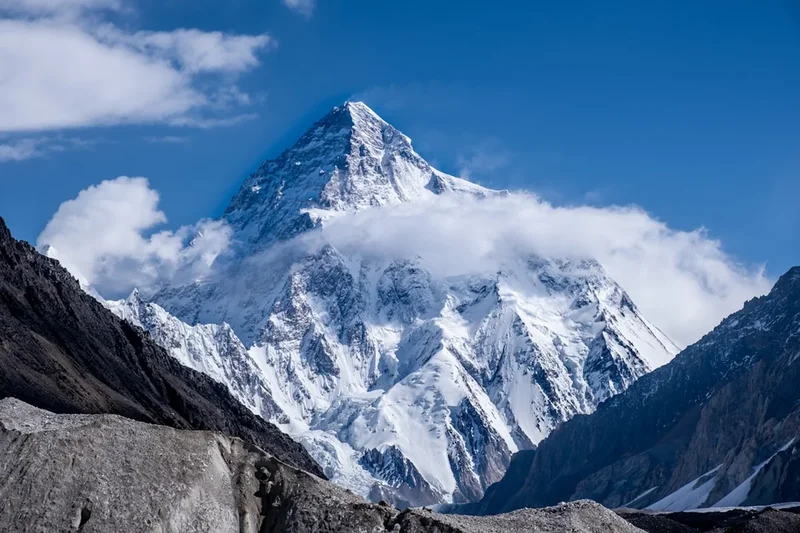
K2 Base Camp Trek - Journey to the Throne Room of the Mountain Gods
The K2 Base Camp Trek, often referred to as the "Throne Room of the Mountain Gods," is arguably the most spectacular high-altitude trek on the planet. Located in the heart of the Karakoram Range in Gilgit-Baltistan, Pakistan, this journey takes adventurers deep into a landscape of unparalleled verticality. Unlike the more commercialised routes in the Himalayas, the trek along the Baltoro Glacier remains a raw, challenging, and profoundly isolating experience. It is a 120-kilometre round trip that culminates at Concordia, the majestic confluence of the Baltoro and Godwin-Austen glaciers, where four of the world’s fourteen 8,000-metre peaks—K2, Broad Peak, Gasherbrum I, and Gasherbrum II—stand in a staggering 360-degree amphitheatre of ice and rock. This is not merely a walk; it is an expedition into the geological soul of the earth, requiring physical resilience, mental fortitude, and a deep respect for the volatile nature of high-mountain environments.
- Distance: 120.0 km (approximate round trip from Askole)
- Duration: 14–16 days
- Elevation Gain: 4,500 m (cumulative)
- Maximum Elevation: 5,150 m (K2 Base Camp) or 5,600 m (if crossing Gondogoro La)
- Difficulty: Very Challenging
- Best Time: June to September
- Closest City: Skardu, Pakistan
- Accommodation: Full wilderness camping (no permanent huts or lodges)
Overview
The K2 Base Camp Trek is the definitive mountain adventure for those seeking to witness the world’s second-highest peak, K2 (8,611 m), in its most intimate setting. The journey begins in the remote village of Askole, the final outpost of civilisation before the road ends and the wilderness of the Central Karakoram National Park begins. From here, the trail follows the Braldu River before ascending onto the mighty Baltoro Glacier, one of the longest glaciers outside the polar regions, stretching over 63 kilometres in length. The terrain is a relentless mix of loose scree, shifting glacial moraine, and solid ice, demanding constant focus and sturdy footwear.
What sets this trek apart is the sheer density of high peaks. As you move up the glacier, the landscape evolves from the arid, brown valleys of the lower Shigar region into a vertical world of granite spires and ice-clad giants. You will pass beneath the iconic Trango Towers—sheer granite walls that are the dream of every big-wall climber—and the massive bulk of Masherbrum (7,821 m). The climax of the trek is Concordia. Standing at this junction, the scale of the mountains is almost impossible to comprehend. K2 looms to the north, a near-perfect pyramid of rock and ice that dominates the horizon, while Broad Peak and the Gasherbrum massif frame the eastern view. For many, the experience of watching the sunset over K2 from a tent at Concordia is the pinnacle of a lifetime of trekking.
Logistically, the trek is a significant undertaking. There are no "teahouses" or permanent settlements along the route. Every gram of food, every tent, and every litre of fuel must be carried in by porters or mules. This creates a unique bond between the trekkers and the local Balti people, whose strength and hospitality are legendary. The environment is harsh, with temperatures ranging from 30°C in the lower valleys to -15°C at night on the upper glacier. However, for those prepared to endure the dust, the cold, and the physical exertion, the reward is a front-row seat to the most dramatic mountain scenery on Earth.
History and Cultural Context
The history of the K2 Base Camp route is inextricably linked to the golden age of mountaineering and the "Great Game" of the 19th century. While the local Balti people have navigated these valleys for centuries, often crossing high passes like the Mustagh Pass for trade with Yarkand in China, the region remained a mystery to the Western world until the late 1800s. In 1887, Francis Younghusband became one of the first Europeans to cross the Mustagh Pass, bringing back tales of the immense glaciers and towering peaks of the Karakoram.
The naming of K2 itself is a relic of the Great Trigonometrical Survey of British India. In 1856, Thomas Montgomerie surveyed the peaks from a distance of over 200 kilometres, labelling the prominent peaks of the Karakoram as K1, K2, K3, and so on. While other peaks eventually regained their local names (K1 became Masherbrum), K2 remained K2, partly because its extreme remoteness meant it had no widely used local name at the time. Later, it was named Mount Godwin-Austen in honour of Henry Godwin-Austen, an early explorer, though K2 remains the internationally recognised designation.
The trekking route we follow today was pioneered by early climbing expeditions. The 1909 expedition led by the Duke of Abruzzi was a landmark event, reaching high onto the slopes of K2 and providing the first detailed maps and photographs of the Baltoro Glacier. The cultural heart of the trek lies with the Balti people. Descendants of Tibetan and Central Asian migrants, the Balti are predominantly Shia Muslims with a rich tradition of mountain lore. Their language, Balti, is an archaic dialect of Tibetan. For the porters of Askole and the Shigar Valley, the Baltoro Glacier is not just a trekking route but a workplace and a sacred landscape. Their resilience in carrying 25-kilogram loads over shifting ice in plastic sandals is a humbling sight that forms an essential part of the trek's cultural narrative.
Want more background? Read extended notes on history and cultural context → Learn more
Seasonal Highlights and Weather Reality
The window for trekking to K2 Base Camp is narrow, dictated by the extreme continental climate of Northern Pakistan. Unlike the Nepal Himalayas, which have two distinct trekking seasons, the Karakoram is best visited during the summer months.
Summer (June to August): This is the primary trekking season. In June, the upper passes may still have significant snow, but the lower valleys are blooming. July and August are the most popular months, offering the warmest temperatures and the clearest skies. However, this is also when the heat in the lower valleys (Skardu and Askole) can be intense, often exceeding 35°C. On the glacier, daytime temperatures are pleasant, but the sun's reflection off the ice is exceptionally strong, requiring high-factor sun protection. While Pakistan experiences a monsoon, the Karakoram range lies partially in a rain shadow; however, "tail-end" monsoon storms can still bring heavy rain or snow to the Baltoro in August, potentially delaying flights or blocking roads.
Shoulder Season (September): Early September can be a magical time to trek. The crowds (which are small even in peak season) dissipate, and the air becomes incredibly crisp and clear. The autumn colours begin to appear in the lower valleys. However, the risk of early winter storms increases significantly, and temperatures at Concordia can drop well below -10°C at night. By late September, most trekking companies have ceased operations as the porters return to their villages for the harvest.
Winter (October to May): Trekking during this period is strictly for professional winter expeditions. The Baltoro Glacier becomes a frozen wasteland of deep snow and lethal temperatures (reaching -40°C). The road to Askole is frequently blocked by snow and landslides, and the high passes are impassable without advanced mountaineering equipment and survival skills. Most of the region's infrastructure, including the domestic flights to Skardu, becomes highly unreliable.
Recommended Itinerary
14-Day K2 Base Camp (Baltoro Glacier) Itinerary
Day 1: Skardu to Askole
- Distance: 100 km (by Jeep)
- Elevation: 2,230 m to 3,040 m
- Time: 6–8 hours
- A rugged 4x4 journey through the Shigar Valley
- Cross the Braldu River on precarious suspension bridges
- Arrive at Askole, the last village before the wilderness
- Final gear check and meeting with the porter team
Day 2: Askole to Korophon
- Distance: 13 km
- Elevation gain: 100 m
- Time: 4–5 hours
- Relatively flat walk along the Braldu River
- Introduction to the arid, dusty terrain of the lower Karakoram
- First views of the Biafo Glacier snout
- Camp at Korophon, a green oasis near the river
Day 3: Korophon to Jhola
- Distance: 10 km
- Elevation gain: 150 m
- Time: 3–4 hours
- Cross the Dumordo River via a bridge (formerly a "jola" or pulley system)
- The trail is rocky and exposed to the sun
- Views of Bakhor Das peak
- Short day to allow for acclimatisation to the heat and dust
Day 4: Jhola to Paiju
- Distance: 20 km
- Elevation gain: 250 m
- Time: 7–8 hours
- A long, demanding day following the Braldu River
- The trail climbs and descends over several bluffs
- First glimpses of the Baltoro Glacier snout in the distance
- Paiju is a famous campsite with ancient trees and the last running water before the glacier
Day 5: Rest and Acclimatisation at Paiju
- Distance: 0 km
- Elevation: 3,400 m
- Essential day for porters to bake bread for the glacier journey
- Trekkers can take short walks for better views of the Cathedral Peaks
- Health checks and hydration focus
Day 6: Paiju to Khoburtse
- Distance: 15 km
- Elevation gain: 500 m
- Time: 6–7 hours
- Step onto the Baltoro Glacier for the first time
- Walking on "dead" glacier (ice covered in thick rock and debris)
- Stunning views of Trango Towers and Uli Biaho
- Camp on the edge of the glacier at Khoburtse
Day 7: Khoburtse to Urdukas
- Distance: 7 km
- Elevation gain: 250 m
- Time: 3–4 hours
- Short but steep climb to a spectacular campsite
- Urdukas is located on a grassy slope overlooking the glacier
- Direct views of the Great Trango Tower and Nameless Tower
- Last campsite on solid ground before moving onto the medial moraine
Day 8: Urdukas to Goro II
- Distance: 12 km
- Elevation gain: 300 m
- Time: 6–7 hours
- Walk in the centre of the glacier on the medial moraine
- Pass the massive Masherbrum (7,821 m) to the south
- Camp directly on the ice (Goro II)
- Temperatures drop significantly as you are surrounded by ice
Day 9: Goro II to Concordia
- Distance: 12 km
- Elevation gain: 250 m
- Time: 5–6 hours
- The most iconic day of the trek
- The glacier levels out as you approach the "Throne Room"
- K2 gradually reveals itself in all its glory
- Arrive at Concordia (4,600 m), the junction of glaciers
- 360-degree views of K2, Broad Peak, and Gasherbrum IV
Day 10: Concordia to K2 Base Camp and return
- Distance: 20 km (round trip)
- Elevation gain: 550 m
- Time: 8–10 hours
- Early start to walk up the Godwin-Austen Glacier
- Pass Broad Peak Base Camp
- Reach K2 Base Camp (5,150 m) at the foot of the Abruzzi Spur
- Visit the Gilkey Memorial
- Return to Concordia for the night
Day 11: Concordia to Ali Camp (or start return)
- Distance: 12 km
- Elevation gain: 200 m
- Time: 5–6 hours
- If crossing Gondogoro La, move to Ali Camp
- If returning via Baltoro, begin the descent to Goro I
- Final sunset views of K2
Day 12–14: Return to Askole
- Distance: ~60 km (total)
- Descent: 1,500 m
- Rapid descent back through Urdukas, Paiju, and Jhola
- Legs are tired but the air becomes richer in oxygen
- Final night in Askole before the Jeep ride back to Skardu
Important Notes:
- The itinerary is subject to change based on weather and glacial conditions.
- Acclimatisation days are non-negotiable to prevent altitude sickness.
- Walking on the glacier is physically draining due to the uneven surface.
- Porters are the lifeblood of this trek; treat them with respect and follow their lead on the ice.
Planning and Bookings
Book Your Trip
Everything you need to plan your journey
Accommodation
Find places to stay near Skardu
Flights
Search flights to Skardu
Essential Preparation
The K2 Base Camp trek is not a journey you can undertake on a whim. It requires months of physical conditioning and logistical coordination. Unlike Nepal, where independent trekking is common, the K2 Base Camp trek is located in a restricted zone. This means you must book through a licensed Pakistani trekking agency. They will handle the mandatory government permits, the licensed guide (required by law), and the complex logistics of hiring porters, mules, and cooks.
Fitness is paramount. You should be capable of walking 6–8 hours a day for multiple days in a row, often on unstable terrain. Training should include weighted pack walks, stair climbing, and cardiovascular endurance work. Additionally, you must fly into Islamabad and then take a domestic flight to Skardu. The Islamabad-Skardu flight is "weather dependent"—if the pilots cannot see the mountains, they do not fly. Always build at least 2–3 buffer days into your international travel schedule to account for flight cancellations.
Trail Accommodation
There are no permanent buildings, huts, or lodges on the K2 Base Camp trek. This is a 100% wilderness camping experience. Your trekking agency will provide the necessary equipment, but it is important to know what to expect.
Camping Facilities:
- Sleeping Tents: Usually 2-person "A-frame" or dome tents. You will be sleeping on foam mats provided by the agency.
- Mess Tent: A large communal tent where meals are served and trekkers can socialise in the evenings.
- Toilet Tents: Small privacy tents set up over a dug-out pit. These are moved at each camp.
- Kitchen Tent: Where the crew prepares all meals.
- Water: Sourced from glacial melt or streams. It is boiled or treated by the kitchen staff, but personal filtration is recommended.
What is NOT Provided:
- Sleeping Bags: You must bring your own high-quality, four-season sleeping bag (rated to -15°C or lower).
- Pillows: Most trekkers use a stuff-sack filled with clothes.
- Electricity: There are no charging points. You must bring solar chargers or high-capacity power banks.
- Showers: There are no shower facilities. Most trekkers rely on "wet wipe baths" or small bowls of warm water provided by the staff.
Required Gear
- Mountaineering Boots: Sturdy, waterproof, and well-broken-in. They must have stiff soles for walking on rocks and ice.
- Camp Shoes: Lightweight trainers or Crocs for use in the evenings.
- Four-Season Sleeping Bag: Down-filled is best for weight and warmth.
- Down Jacket: A heavy-duty "summit" style jacket for evenings at Concordia.
- Hard-shell Jacket and Trousers: Gore-Tex or equivalent for wind and rain protection.
- Trekking Poles: Essential for stability on the shifting moraine of the Baltoro.
- Crampons or Micro-spikes: Necessary if you are crossing the Gondogoro La or if the glacier is particularly icy.
- Headlamp: With several sets of spare batteries.
- Backpack: A 30–40L daypack for your daily essentials (water, snacks, layers). Your main kit will be carried by porters.
What to Bring
- Water Purification: Katadyn filters or SteriPens are excellent backups to the boiled water provided.
- High-Calorie Snacks: Energy bars, nuts, dried fruit, and chocolate. The food provided is nutritious but you will crave variety.
- Electrolyte Powder: To stay hydrated in the dry, high-altitude air.
- Sun Protection: SPF 50+ sunscreen, lip balm with SPF, and Category 4 glacier sunglasses (essential to prevent snow blindness).
- Personal First Aid Kit: Including blister pads (Compeed), Ibuprofen, Diamox (for altitude), and broad-spectrum antibiotics.
- Toiletries: Biodegradable soap, wet wipes, hand sanitiser, and a quick-dry towel.
- Solar Charger: To keep your camera and phone powered for the duration of the trek.
- Cash: Pakistani Rupees (PKR) for tipping the porters and guides at the end of the trek. This is a significant part of their income.
Permits
Obtaining permits for the K2 Base Camp trek is a bureaucratic process that must be initiated at least 2–3 months before your arrival in Pakistan. Because the trek enters a restricted area near the borders with China and India, the Pakistani government requires several layers of authorisation.
The Trekking Permit and NOC:
- No Objection Certificate (NOC): This is the primary document issued by the Ministry of Tourism in Islamabad. It grants you permission to enter the restricted zone of the Central Karakoram National Park.
- Licensed Guide: You cannot get an NOC without a licensed guide. The guide must accompany you from Skardu and is responsible for checking in at various military and police posts along the route.
- Environmental Fee: A fee is paid to the Central Karakoram National Park (CKNP) for the maintenance and cleaning of the trail.
- Insurance: You must have travel insurance that specifically covers "mountaineering" and "helicopter evacuation" up to 6,000 metres. The Pakistani military handles helicopter rescues, and they require a cash deposit or a guaranteed insurance bond before they will scramble a flight.
The Process:
Your chosen trekking agency will require a scanned copy of your passport, your Pakistan visa, and several passport-sized photographs. They will submit these to the Ministry of Tourism. Once the NOC is issued, you will often have a "briefing" at the Department of Tourism in Islamabad or Skardu before starting the trek, and a "de-briefing" upon your return. This is to ensure all environmental regulations were followed and that all members of the party returned safely.
Visa Information:
Most nationalities can now apply for a Pakistan Trekking Visa online via the E-Visa portal. You will need a "Letter of Invitation" (LOI) from your trekking agency to complete this application. Do not apply for a standard Tourist Visa, as it may not be valid for restricted trekking areas.
Other Activities in the Area
The Gilgit-Baltistan region is a treasure trove of natural beauty and culture. If you have extra time in Skardu or the surrounding valleys, consider these activities:
- Deosai Plains: Known as the "Land of the Giants," this is the second-highest plateau in the world. It is a vast, rolling landscape of wildflowers and clear streams, home to the Himalayan Brown Bear. It is a 2-hour Jeep drive from Skardu.
- Kharpocho Fort: Perched high above Skardu town, this 16th-century fort offers incredible views of the Indus River and the Skardu Valley.
- Satpara Lake: A stunning turquoise lake just outside Skardu, perfect for a relaxing afternoon before or after your trek.
- Shigar Valley: Visit the beautifully restored Shigar Fort (now a Serena Hotel) and the ancient mosques of the valley. It is a peaceful contrast to the ruggedness of the Baltoro.
- Cold Desert of Skardu (Katpana Desert): One of the highest deserts in the world, where sand dunes are often covered in snow during winter. It is a surreal landscape for photography.
- Manthoka Waterfall: A spectacular 55-metre waterfall in the Kharmang Valley, about 2 hours from Skardu.
Safety and Conditions
Altitude Sickness (AMS): This is the single greatest risk on the K2 Base Camp trek. You will be spending over a week above 4,000 metres. It is essential to follow the "climb high, sleep low" principle and never skip acclimatisation days. Recognise the symptoms of Acute Mountain Sickness (headache, nausea, dizziness) and be prepared to descend immediately if symptoms worsen into HAPE (High Altitude Pulmonary Edema) or HACE (High Altitude Cerebral Edema).
Glacial Hazards: The Baltoro is an active glacier. This means the terrain is constantly changing. Crevasses, ice falls, and shifting boulders are common. Always follow your guide’s path, especially when crossing the medial moraine or navigating the "ice highway" near Goro II. In late summer, meltwater streams on the glacier can become torrents that are difficult to cross.
Weather Extremes: The Karakoram is known for its "micro-climates." A perfectly clear morning at Concordia can turn into a blizzard within an hour. Hypothermia is a real risk if you are caught in wet or windy conditions without proper layers. Conversely, the sun at high altitude is fierce; heat exhaustion and severe sunburn are common among unprepared trekkers.
Rockfall: In the lower valleys, particularly between Jhola and Paiju, the trail passes beneath steep cliffs. Rockfall is a constant hazard, especially after rain or in the heat of the afternoon when ice melts and releases stones. Wear a helmet if your guide suggests it in specific sections.
Evacuation: There are no roads or hospitals on the Baltoro Glacier. In the event of a serious injury or illness, the only way out is by Pakistan Army helicopter. This is expensive and weather-dependent. Ensure your insurance is in order and you have a satellite communication device (like a Garmin inReach) if your agency does not provide one.
Side Trips and Points of Interest
The Gilkey Memorial: Located a short walk from K2 Base Camp, this somber site is a collection of metal plates and cairns commemorating the climbers who have lost their lives on K2. It is named after Art Gilkey, who died during the 1953 American expedition. It is a powerful place for reflection on the cost of high-altitude ambition.
Broad Peak Base Camp: On the way to K2 Base Camp, you will pass the staging area for expeditions to Broad Peak (8,051 m). It is often a lively place in July, filled with climbers from around the world. It offers a unique perspective on the "mountaineering village" culture.
Gondogoro La (5,600 m): For those seeking an even greater challenge, the trek can be completed as a loop by crossing the Gondogoro La pass. This requires basic mountaineering skills (using a fixed rope and jumar) and an ice axe. The view from the top of the pass is arguably the best in the world, looking down on all four 8,000-metre peaks at once. However, it is a dangerous pass prone to rockfall and avalanches, and it is only open when conditions allow.
Trango Towers Viewpoint: Near the Khoburtse camp, there is a specific ridge that offers a perfectly framed view of the Trango Group. These are the tallest vertical granite cliffs in the world, and seeing them up close is a highlight for many trekkers.
Leave No Trace
The Central Karakoram National Park is a fragile high-altitude ecosystem. With the increasing number of trekkers, the impact on the Baltoro Glacier has become a serious concern. As a visitor, you have a moral obligation to minimise your footprint.
Environmental Guidelines:
- Waste Management: Pack out everything. Your agency should have a strict policy for carrying out all non-biodegradable waste. Ensure that your group’s trash is not being buried in the glacier, as it will eventually resurface.
- Human Waste: Use the designated toilet pits at campsites. On the glacier, follow the specific instructions of your guide to ensure waste is managed in a way that doesn't contaminate meltwater.
- Water Protection: Do not use soap or detergents directly in streams or glacial pools. Carry water 20 metres away from the source for washing.
- No Fires: Wood is extremely scarce in the Karakoram. Never use local vegetation for fires. All cooking should be done on kerosene or gas stoves brought from Skardu.
- Respect Wildlife: If you are lucky enough to see a Snow Leopard, Himalayan Ibex, or Golden Eagle, keep your distance and do not disturb them.
- Cultural Respect: Ask permission before taking photos of local people, especially women. Dress modestly in the villages of Askole and Shigar.
 Nepal
Nepal