
Croagh Patrick - Ireland's Holy Mountain
Croagh Patrick, affectionately known as "The Reek" by locals, is more than just a mountain; it is a profound symbol of Irish heritage, spirituality, and natural beauty. Rising 764 metres above the shimmering waters of Clew Bay in County Mayo, its distinctive conical shape dominated by white quartzite scree makes it one of the most recognisable landmarks in Western Europe. For over 5,000 years, this peak has served as a site of ritual and reflection, transitioning from a pagan sanctuary celebrating the harvest festival of Lughnasadh to the premier site of Christian pilgrimage in Ireland. Every year, particularly on "Reek Sunday" (the last Sunday in July), thousands of pilgrims and hikers make the arduous journey to the summit, some continuing the ancient tradition of climbing barefoot as an act of penance or devotion.
The trail is a 7.0 km round trip that demands respect. While the distance may seem modest, the vertical gain of 764 metres over a relatively short horizontal span creates a steep and challenging ascent. The terrain is famously rugged, characterised by loose rock and a demanding final "cone" that tests the resolve of even experienced hillwalkers. However, the reward for reaching the summit is unparalleled: a 360-degree panorama that encompasses the 365 drumlin islands of Clew Bay, the wild expanse of the Nephin Beg Range, and the rugged coastline of the Atlantic Ocean. Whether you are seeking a spiritual connection, a physical challenge, or simply the finest views in Connacht, Croagh Patrick offers an experience that resonates long after the descent is complete.
- Distance: 7.0 km return
- Elevation Gain: 764 m
- Duration: 3–5 hours
- Difficulty: Moderate to Strenuous (due to steepness and loose scree)
- Best Time: April to September
- Closest Town: Westport (10 km away)
- Trailhead: Murrisk Car Park (GPS: 53.7604, -9.7683)
Overview
The ascent of Croagh Patrick is a journey through layers of Irish history and geology. The mountain is primarily composed of quartzite, which gives the upper slopes their shimmering, almost ethereal appearance in the Atlantic light. This same rock, however, breaks down into the notorious "scree"—small, loose stones that make the final third of the climb a slippery and technical endeavour. In recent years, a massive sustainable access project has seen local stonemasons hand-craft a magnificent stone staircase on the steepest sections, significantly improving the safety and sustainability of the route while preserving its rugged character.
The walk begins at sea level in the village of Murrisk, passing the iconic statue of Saint Patrick before entering the lower slopes. The first section is a steady climb on a well-defined path through rough grazing land. As you gain height, the views behind you begin to open up, revealing the intricate tapestry of Clew Bay. Legend says there is an island for every day of the year in the bay—a claim that seems entirely plausible when viewed from the heights of the mountain. These "drumlins" are drowned glacial hills, a remnant of the last Ice Age that created one of the most unique coastal landscapes in the world.
The midpoint of the hike is "The Shoulder" (Leacht Benáin), a flat plateau that provides a much-needed reprieve before the final assault on the summit cone. From here, the mountain takes on its most dramatic form, rising steeply toward the sky. The summit itself is home to a small, modern chapel, built in 1905, where Mass is celebrated on pilgrimage days. Standing at the top, with the wind whipping off the Atlantic and the entire west of Ireland spread out beneath you, it is easy to understand why this peak has been considered sacred for millennia. The descent requires just as much concentration as the ascent, as the loose stones demand careful foot placement to avoid slips.
History and Cultural Context
The history of Croagh Patrick is inextricably linked to the story of Saint Patrick, Ireland's patron saint. According to hagiographical tradition, Patrick spent forty days and forty nights fasting and praying on the summit in the year 441 AD. During this time, he is said to have banished the "snakes" from Ireland—a metaphor for the eradication of pagan practices and the establishment of Christianity. The mountain was originally known as Cruachán Aigle (Mount of the Eagle), and archaeological evidence suggests it was a site of significant importance long before Patrick's arrival. A hillfort discovered on the summit indicates that the mountain was a place of assembly and ritual as far back as the Bronze Age.
The pilgrimage tradition is one of the oldest in Europe. For centuries, the "Tochar Phádraig" (Patrick's Causeway) served as the main route to the mountain. This 35 km ancient pilgrim path starts at Ballintubber Abbey and winds through the Mayo countryside, following the route Patrick is said to have taken. While most modern visitors start their climb at Murrisk, the Tochar remains a popular route for those seeking a deeper, multi-day spiritual experience. The peak's association with the harvest festival of Lughnasadh suggests that the Christian pilgrimage was an intentional overlay on an existing pagan tradition of mountain-top assembly.
In 1905, local men from the surrounding parishes carried building materials up the mountain on their backs and by donkey to construct the small chapel that stands on the summit today. This feat of endurance and faith is a testament to the mountain's importance to the local community. Today, Croagh Patrick remains a living cultural site. It is not a museum or a static monument but a place where thousands of people continue to express their faith, their connection to the land, and their personal resilience. The mountain is also a focal point for the "Sustainable Access and Habitat Restoration Project," a community-led initiative to repair the damage caused by decades of heavy footfall, ensuring that the "Holy Mountain" remains accessible for future generations.
Want more background? Read extended notes on history and cultural context → Learn more
Seasonal Highlights and Weather Reality
The weather on Croagh Patrick is dictated by its proximity to the Atlantic Ocean. Conditions can change with startling rapidity, and it is not uncommon to experience "four seasons in one day." The best time to climb is generally between April and September, when the days are longer and the probability of clear skies is higher. However, even in mid-summer, the summit can be shrouded in "The Reek's Mist," a thick cloud that can reduce visibility to a few metres in minutes.
Spring (April–May): This is a beautiful time to visit, as the surrounding bogland begins to wake up and the air is often crisp and clear. The temperatures are cool, making the steep climb more comfortable than in the heat of summer. However, late spring showers are common, and the upper slopes can still be quite cold.
Summer (June–August): This is the peak season for both hikers and pilgrims. The long Irish twilight means you can climb late into the evening, often enjoying spectacular sunsets over the Atlantic. Reek Sunday (the last Sunday in July) sees the mountain at its busiest, with up to 25,000 people attempting the climb in a single day. If you prefer solitude, avoid this weekend. Summer also brings the highest risk of heat exhaustion on the exposed slopes, as there is no shade on the mountain.
Autumn (September–October): The heather on the lower slopes turns a vibrant purple, and the light takes on a golden quality that is perfect for photography. The crowds begin to thin, but the weather becomes more unpredictable, with Atlantic depressions bringing wind and rain more frequently.
Winter (November–March): Climbing Croagh Patrick in winter is a serious undertaking. The mountain is frequently battered by gale-force winds, and the upper cone can become covered in ice or snow. The loose scree becomes even more treacherous when frozen. Only experienced hikers with appropriate winter gear and navigation skills should attempt the climb during these months. Daylight is also very limited, with the sun setting as early as 4:00 PM in December.
Recommended Itinerary
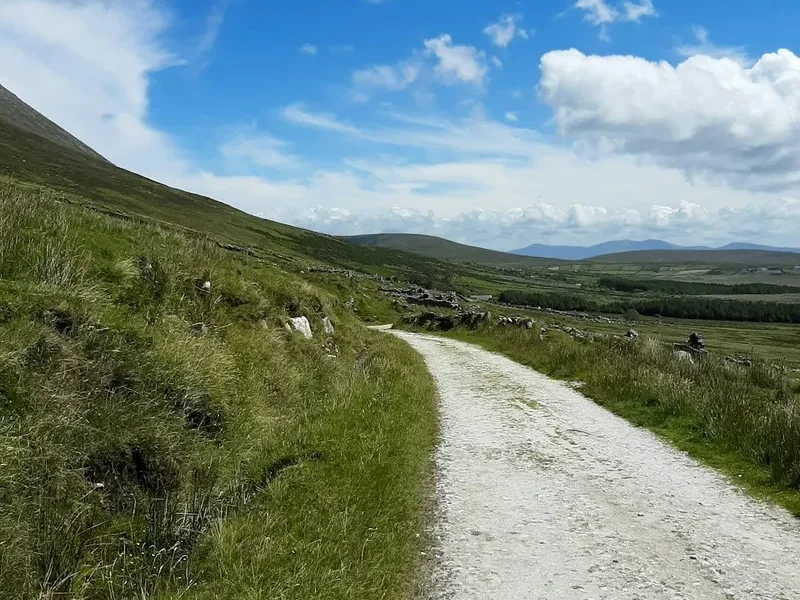
Croagh Patrick Day Hike Route
Phase 1: Murrisk Trailhead to the Statue of Saint Patrick
- Distance: 0.5 km
- Elevation gain: 50 m
- Time: 10–15 minutes
- Start at the Murrisk car park, located opposite the National Famine Monument.
- Follow the well-marked path past the craft shops and café.
- Reach the white statue of Saint Patrick, a traditional place for pilgrims to pause and pray.
- This section is easy and serves as a good warm-up for the steep climb ahead.
Phase 2: The Lower Slopes to the First Ridge
- Distance: 1.5 km
- Elevation gain: 250 m
- Time: 30–45 minutes
- The path becomes steeper and more rugged as you leave the statue behind.
- The terrain consists of packed earth and small stones, bordered by gorse and heather.
- As you ascend, the views of Murrisk Abbey and Clew Bay begin to expand.
- The gradient is steady, requiring a consistent pace to manage exertion.
Phase 3: The Ridge to the Shoulder (Leacht Benáin)
- Distance: 1.0 km
- Elevation gain: 150 m
- Time: 20–30 minutes
- The path levels out slightly as you reach the "Shoulder" of the mountain.
- This is a wide, flat plateau that offers the first views of the southern side of the mountain toward the Sheeffry Hills.
- Leacht Benáin is a traditional station where pilgrims perform ritual circuits.
- This is the best place for a snack and water break before the final, most difficult section.
Phase 4: The Final Cone (The Scree Slope)
- Distance: 0.5 km
- Elevation gain: 314 m
- Time: 45–60 minutes
- This is the most challenging part of the hike. The gradient increases significantly.
- The path consists of loose quartzite scree, which can be very slippery underfoot.
- Utilise the newly constructed stone steps where available to improve stability and protect the mountain from erosion.
- The "false summits" can be mentally taxing; keep your eyes on your footing and take frequent short breaks.
Phase 5: The Summit and Chapel
- Distance: N/A (Summit area)
- Elevation: 764 m
- Time: 20–30 minutes (exploration)
- Arrive at the summit plateau, which is surprisingly large and flat.
- Visit the small chapel (St. Patrick's Oratory) and the various "stations" marked by stone cairns.
- Enjoy the 360-degree views: Clew Bay to the north, the Nephin Beg range to the northeast, and the mountains of Connemara to the south.
- On a clear day, you can see as far as the Twelve Bens and Achill Island.
Phase 6: The Descent to Murrisk
- Distance: 3.5 km
- Elevation: 764 m loss
- Time: 1.5–2 hours
- Retrace your steps carefully down the cone. The loose scree is often more difficult on the way down.
- Use trekking poles if you have them to save your knees and improve balance.
- Once past the Shoulder, the descent becomes easier, but fatigue can lead to trips, so stay focused.
- Finish back at Murrisk for a well-earned meal in one of the local pubs.
Important Notes:
- No permits are required, but parking fees apply at the Murrisk car park.
- The mountain is open year-round, but weather is the primary safety factor.
- The climb is physically demanding; ensure you have a basic level of fitness.
- Respect the religious significance of the site, even if you are climbing for recreation.
- The stone steps are a result of years of hard work; please stay on the designated path to prevent further erosion.
Planning and Bookings
Book Your Trip
Everything you need to plan your journey
Accommodation
Find places to stay near Westport
Flights
Search flights to Westport
Essential Preparation
Croagh Patrick is a high-intensity day hike that requires no advanced bookings or permits, making it an accessible adventure for most visitors to the West of Ireland. However, "accessible" should not be confused with "easy." The primary preparation involves assessing your physical fitness and monitoring the weather. The ascent involves over 750 metres of vertical climbing in less than 4 kilometres, which is a significant workout for the legs and cardiovascular system.
Westport is the ideal base for this hike. It is a vibrant, award-winning town with a wide range of accommodation, from luxury hotels to budget-friendly hostels. It is also a hub for outdoor gear, so if you realise you've forgotten your waterproofs or need a pair of trekking poles, you can easily find them here. During the summer months and especially around Reek Sunday, accommodation in Westport and Murrisk fills up months in advance, so book early if you plan to visit during peak pilgrimage season.
Trail Accommodation
This is a day hike requiring no overnight accommodation on the mountain itself. Camping is strictly prohibited on Croagh Patrick to protect the fragile alpine environment and respect the sacred nature of the site. There are no mountain huts or shelters for public use.
Nearby Options:
- Murrisk: There are several high-quality B&Bs and a caravan/camping park located within walking distance of the trailhead. This is the best option if you want to start your climb very early in the morning.
- Westport: Located 10 km (a 15-minute drive) from the trailhead, Westport offers the most variety. Options include the Westport Coast Hotel, various boutique guesthouses, and the popular Old Mill Hostel.
- Louisburgh: A smaller village located 12 km to the west of the mountain, offering a quieter alternative to Westport with several charming B&Bs.
Required Gear
- Hiking Boots: Essential. The loose quartzite scree on the upper cone is sharp and unstable. Ankle support and a stiff, high-grip sole (like Vibram) are non-negotiable for safety and comfort.
- Waterproof Jacket: Even on a sunny day, the Atlantic weather can bring sudden downpours. A breathable, high-quality waterproof shell is a must.
- Layered Clothing: Use a moisture-wicking base layer (merino wool or synthetic), an insulating mid-layer (fleece), and your outer shell. The temperature at the summit is typically 5–7°C cooler than at sea level, and wind chill can make it feel much colder.
- Trekking Poles: Highly recommended. They provide essential stability on the loose scree during the ascent and significantly reduce the impact on your knees during the steep descent.
- Small Backpack: A 15–25L pack is sufficient to carry your layers, food, and water.
- Sun Protection: The mountain is completely exposed. Even on overcast days, the UV levels can be high. Bring sunscreen, sunglasses, and a hat.
What to Bring
- Water: At least 1.5 to 2 litres per person. There are no reliable water sources on the mountain, and the physical exertion will lead to significant fluid loss.
- High-Energy Snacks: Bananas, nuts, chocolate, or energy bars are perfect for a quick boost at the Shoulder or the summit.
- Packed Lunch: If you plan to spend time at the summit enjoying the views, bring a more substantial sandwich or wrap.
- Mobile Phone: Ensure it is fully charged. While signal is generally good on the mountain, it can be patchy in the valleys.
- Basic First Aid: Plasters (especially for blisters), antiseptic wipes, and any personal medication.
- Whistle: A standard safety item for mountain hiking to signal for help in low visibility.
- Camera/Smartphone: The views of Clew Bay are some of the most photographed in Ireland.
Permits
There are no permits required to climb Croagh Patrick. The mountain is open to the public 365 days a year. However, there are some logistical costs and considerations to keep in mind when planning your visit.
Parking Fees: The main car park in Murrisk is managed by the local community and Mayo County Council. There is a small fee (typically €3–€5) for parking. This revenue goes toward the maintenance of the facilities, including the public toilets and the car park itself. During peak times, this car park fills up very quickly, and you may need to use overflow parking areas, which are also usually paid.
Voluntary Donations: You will often see collection boxes or opportunities to donate to the Croagh Patrick Stakeholders Group. This group manages the "Sustainable Access and Habitat Restoration Project." Given the immense cost of hand-building the stone path and restoring the eroded mountainside, donations from hikers are greatly appreciated and directly contribute to the mountain's future.
Group Events: If you are organising a large charity climb or a commercial event (more than 20 people), it is common courtesy and often a requirement to notify the Croagh Patrick Stakeholders Group or the local parish office in Murrisk. This helps manage the impact on the mountain and ensures that your event does not clash with major religious ceremonies.
Access Restrictions: While the mountain is generally open, the Department of Rural and Community Development or the local authorities may occasionally issue "Mountain Closed" notices during extreme weather events (such as status red wind warnings) or during major path maintenance works. Always check local news or the Mayo County Council website if severe weather is forecast.
Other Activities in the Area
County Mayo is a playground for outdoor enthusiasts and culture seekers. After your climb, consider exploring these nearby attractions:
- The Great Western Greenway: A world-class 42 km off-road cycling and walking trail that follows the route of the old mid-lands Great Western Railway from Westport to Achill Island. It offers stunning views of Clew Bay and the Nephin Mountains.
- Westport House: One of Ireland’s most beautiful historic homes, set in a magnificent estate. It offers house tours, beautiful gardens, and a pirate-themed adventure park for families.
- Clew Bay Boat Tours: Take a trip from Westport Quay to see the drumlin islands up close. Many tours offer wildlife spotting (seals are common) and insights into the history of the bay, including the exploits of the pirate queen Grace O'Malley.
- Achill Island: A 45-minute drive from Westport, Achill is home to some of Ireland's most spectacular cliffs (Croaghaun) and beautiful Blue Flag beaches like Keem Bay.
- Murrisk Abbey: Located right at the foot of Croagh Patrick, these atmospheric ruins of an Augustinian friary date back to 1457 and are well worth a 15-minute stroll.
- National Famine Monument: Located across from the Murrisk car park, this poignant bronze sculpture of a "Coffin Ship" commemorates the victims of the Great Famine of the 1840s.
- Traditional Music in Westport: Westport is famous for its traditional Irish music scene. Pubs like Matt Molloy’s (owned by the flautist of The Chieftains) offer live sessions almost every night of the week.
Safety and Conditions
Pre-Departure Checks:
- Check the Met Éireann mountain forecast specifically for the West of Ireland.
- Be aware that "The Reek" creates its own microclimate; conditions at the base are rarely indicative of conditions at the summit.
- Tell someone your expected return time, especially if climbing alone or in the shoulder season.
- Ensure you have adequate water and food; there are no facilities once you leave the trailhead.
The Scree Hazard: The upper cone of Croagh Patrick is notorious for its loose quartzite scree. This is the most common site for injuries, usually involving twisted ankles or slips. The new stone path has mitigated much of this risk, but sections of loose rock remain. When descending, take small steps, keep your weight slightly forward, and use trekking poles to maintain three points of contact with the ground. Avoid "running" down the scree, as this causes significant erosion and is a primary cause of falls.
Weather and Visibility: Sudden mist can disorientate hikers. If you lose the path in thick cloud, the safest course of action is to stay put until it clears or follow the sound of other hikers if you are certain of their direction. The path is very well-worn, so if you find yourself on grass or untrampled rock, you have likely strayed from the route. In high winds, the ridge and the summit can be dangerous; if you find it difficult to stand, turn back immediately.
Hypothermia: Even in summer, the combination of sweat, wind, and a sudden drop in temperature at the summit can lead to hypothermia. Always carry a dry spare layer (like a lightweight fleece) and put on your waterproof shell before you start to feel cold.
Emergency Services: In the event of a serious injury or emergency, dial 999 or 112 and ask for "Mountain Rescue." The Mayo Mountain Rescue Team is a voluntary organisation that provides an incredible service on Croagh Patrick, but response times can be affected by weather and location on the mountain.
Barefoot Climbing: While a traditional pilgrimage practice, climbing barefoot is not recommended for recreational hikers. The sharp quartzite can cause significant lacerations, and the lack of support increases the risk of ligament injuries. If you choose to climb barefoot for religious reasons, ensure you have footwear in your pack in case of emergency.
Side Trips and Points of Interest
The Statue of Saint Patrick: Located just a few hundred metres from the start, this statue was erected in 1928. It is a focal point for pilgrims and a popular spot for a "starting photo." The statue depicts Patrick with his staff, looking out over the land he converted to Christianity.
Leacht Benáin (Benan's Slab): This is the stone altar located on the Shoulder. It is named after Saint Benan, a disciple of Patrick. Pilgrims traditionally walk seven times around this station while reciting prayers. For the secular hiker, it marks the transition from the "easy" lower slopes to the "hard" final cone.
The Summit Chapel: The current chapel was dedicated in 1905. It is a simple, sturdy structure designed to withstand Atlantic gales. While it is usually locked outside of pilgrimage days and scheduled Masses, its presence adds a unique atmosphere to the summit. On Reek Sunday, Mass is celebrated here every hour from early morning until midday.
The "Bed" of Saint Patrick: Near the chapel is a hollow in the rock known as "St. Patrick's Bed." Tradition says this is where the saint slept during his forty-day fast. It is another of the "stations" where pilgrims perform ritual circuits.
Tochar Phádraig: While not a side trip you can do in an hour, the Tochar Phádraig is the ancient 35 km route from Ballintubber Abbey. If you are a keen long-distance walker, this is the ultimate way to experience Croagh Patrick. It requires a permit from Ballintubber Abbey (to cover insurance on private farmland) and takes a full day of strenuous walking through bog and field before reaching the base of the mountain.
The Views of Clew Bay: On a clear day, the view from the summit is a masterclass in geography. You can see the "drowned drumlins" of the bay, the white sands of Mulranny, the massive bulk of Achill Island, and the distant peaks of the Twelve Bens in Connemara. It is widely considered one of the most beautiful views in Ireland.
Leave No Trace
Croagh Patrick is one of the most heavily trafficked mountains in Ireland, and the impact of hundreds of thousands of feet is visible in the form of severe erosion. As a visitor, you have a responsibility to minimise your impact on this sacred and ecologically sensitive site.
Protecting the Mountain:
- Stay on the Path: This is the most important rule. The "Sustainable Access" project has created a durable stone path. Walking off-trail destroys fragile alpine vegetation and creates new drainage channels that accelerate erosion. Even if the path is crowded, stay on the stones.
- Pack It In, Pack It Out: There are no bins on the mountain. Take all your litter home with you, including "organic" waste like banana skins or orange peels, which take years to decompose in the cold, acidic mountain environment.
- Respect the Wildlife: You may see sheep grazing on the lower slopes. Keep dogs on a lead at all times to avoid distressing livestock and nesting birds.
- No Graffiti: Do not scratch names into stones or the chapel walls. Do not build "stone towers" or cairns; these disturb the soil and are not part of the mountain's natural or cultural heritage.
- Be Considerate: Croagh Patrick is a place of prayer for many. Keep noise levels down, avoid playing music, and be respectful of those performing religious rituals.
- Use Facilities: Use the public toilets at the Murrisk car park before you start your climb. There are no toilet facilities on the mountain.
By following these principles, you help ensure that Croagh Patrick remains a beautiful and spiritual place for the next 5,000 years.
 Ireland