
Banaue Rice Terraces Trek - The Stairway to Heaven
The Banaue Rice Terraces Trek is a journey through a living cultural landscape that has been carved into the mountains of Ifugao, Philippines, for over 2,000 years. Often referred to by Filipinos as the "Eighth Wonder of the World," these terraces represent a monumental feat of ancient engineering, where the ancestors of the indigenous Ifugao people utilised only basic hand tools to transform steep mountain slopes into productive agricultural land. Spanning an elevation gain of approximately 800 metres, this 15-kilometre trek offers more than just physical exertion; it provides a profound window into a pre-colonial way of life that persists despite the pressures of the modern world. The route winds through emerald-green paddies, crosses ancient stone-walled irrigation systems, and passes through traditional hamlets where the rhythm of life is still dictated by the planting and harvesting cycles of the heirloom Tinawon rice.
- Distance: 15.0 km (loop or point-to-point variants)
- Duration: 6–8 hours
- Difficulty: Moderate (steep, uneven stone steps and narrow terrace edges)
- Highest Point: Approximately 1,500 m
- Elevation Gain: 800 m
- Best Time: November to May (dry season)
- Location: Banaue, Ifugao Province, Cordillera Central, Philippines
Overview
The Banaue Rice Terraces are part of a broader complex of terraces in the Cordillera region, though they are perhaps the most famous due to their sheer scale and accessibility from the town of Banaue. Unlike the stone-walled terraces of nearby Batad, the Banaue terraces are primarily constructed from compacted earth and mud, though they are reinforced with sophisticated internal drainage systems that have withstood centuries of tropical typhoons and seismic activity. The trek is a sensory immersion: the sound of rushing water from the "payoh" (irrigation canals) is a constant companion, as is the sight of the "bulul" (rice god) statues that occasionally guard the fields.
Walking the terraces is a lesson in precision. The paths often consist of the very tops of the terrace walls, which can be as narrow as 30 centimetres. To one side is a drop into a muddy paddy; to the other, a steep descent to the next level. This requires a steady foot and a calm head, particularly when the surfaces are slick with morning dew or tropical rain. The landscape is a masterclass in sustainable land management; the Ifugao have managed these forests (known as "muyong") at the top of the mountains to ensure a steady supply of water for the terraces below, creating a closed-loop ecosystem that predates modern environmental science by two millennia.
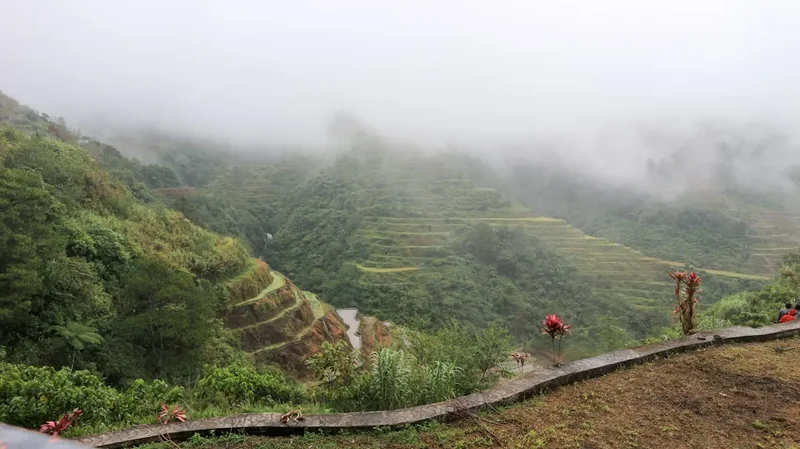
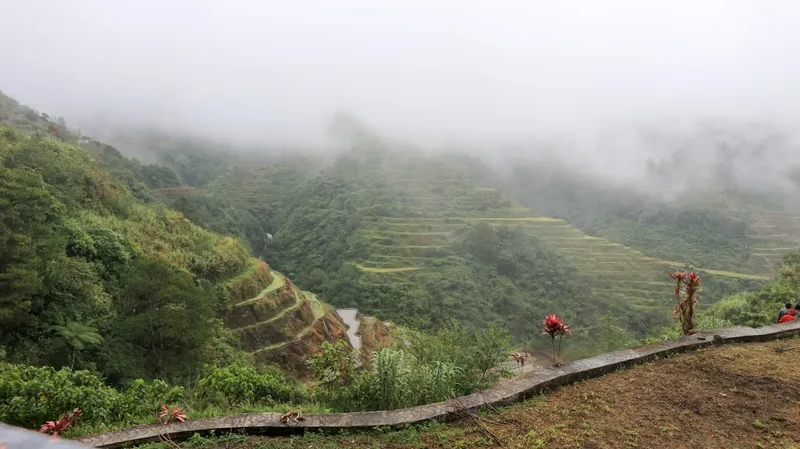
The trek typically begins in the bustling town of Banaue and ascends toward the various viewpoints that offer panoramic vistas of the valley. From these heights, the terraces appear like giant green amphitheatres, their contours following the natural curves of the mountain with an organic grace that no modern machinery could replicate. As you descend into the heart of the paddies, the scale shifts from the monumental to the intimate. You will see farmers tending to the soil with wooden spades, women weaving traditional textiles in the shade of their "fale" (stilt houses), and children navigating the steep steps with an ease that humbles the average trekker. This is not a museum; it is a working agricultural site where every stone and every drop of water is managed with ancestral knowledge passed down through generations.
History and Cultural Context
The history of the Banaue Rice Terraces is inextricably linked to the migration and settlement patterns of the Ifugao people. Archaeological evidence and oral traditions suggest that the construction of the terraces began approximately 2,000 years ago, though some modern scholars debate the exact timeline, suggesting a more recent intensification during the Spanish colonial period as indigenous groups moved higher into the mountains to escape foreign rule. Regardless of the precise date, the terraces represent a collective labour of millions of man-hours. The Ifugao developed a complex social structure based around rice cultivation, where the wealth of a family was measured by the size of their terrace holdings and their ability to host "cañao" (ritual feasts).
The engineering of the terraces is a marvel of hydraulic science. The Ifugao created a system of bamboo pipes and stone-lined canals that distribute water from the mountain springs at the top of the valley down through every single terrace level. This ensures that even the lowest paddies receive adequate hydration without causing erosion to the upper levels. This knowledge was not written down but was preserved through the "Hudhud" chants—epic poems sung by women during the harvest and weeding seasons. These chants, which can last for days, contain the history, law, and agricultural wisdom of the Ifugao people and have been recognised by UNESCO as a Masterpiece of the Oral and Intangible Heritage of Humanity.
In 1995, five clusters of terraces in the Ifugao province were inscribed on the UNESCO World Heritage List. Interestingly, the Banaue Rice Terraces themselves are not part of the UNESCO inscription (due to the presence of modern structures in the town), but they serve as the gateway to the inscribed sites like Batad and Bangaan. The cultural context of the trek is one of resilience. Despite the introduction of Christianity and modern technology, many Ifugao still practice traditional rituals, such as the "post-harvest" ceremonies where pigs or chickens are sacrificed to the bulul to ensure a bountiful next season. Walking these trails is an act of witnessing a culture that has successfully defended its mountain stronghold for centuries.
Want more background? Read extended notes on history and cultural context → Learn more
Seasonal Highlights and Weather Reality
The appearance of the Banaue Rice Terraces changes dramatically depending on the agricultural calendar and the Philippine weather patterns. Understanding these cycles is crucial for planning your trek, as the "classic" green view is only available during specific months.
The Planting Season (January to March): This is often called the "Mirror Phase." The terraces are flooded with water in preparation for planting, and the young rice seedlings are just beginning to sprout. On clear days, the water reflects the sky and the surrounding mountains, creating a stunning, glass-like effect across the valley. The weather is generally cooler and drier, making for comfortable trekking conditions.
The Growing Season (April to June): This is when the terraces are at their most vibrant. The rice stalks grow rapidly, turning the entire landscape into a sea of brilliant, neon green. This is the peak time for photography. However, this period also coincides with the start of the Philippine summer, so temperatures can be high, and the humidity in the mountains can be taxing for trekkers.
The Harvest Season (July to August): The green fades into a deep, golden yellow as the rice ripens. This is a culturally rich time to visit, as you can witness the communal harvest efforts and hear the Hudhud chants echoing across the valleys. However, this is also the height of the typhoon season. Heavy rains can make the trails extremely slippery and dangerous, and landslides are a frequent occurrence in the Cordillera region.
The Post-Harvest/Maintenance Season (September to December): After the harvest, the terraces are cleared, and the soil is turned. The landscape looks more brown and earthy during this time. The weather begins to cool down in November, marking the start of the best trekking window. December is particularly pleasant, with crisp mountain air and clear blue skies, though the terraces will not be green.
Recommended Itinerary
Banaue Rice Terraces Day Trek Itinerary
Early Morning (06:00 – 09:00): Ascent to the Viewpoints
- Start at the Banaue Tourism Office in the town centre for registration and to meet your guide.
- Begin the steady climb along the main road or through the interior mountain paths toward the "Main Viewpoint."
- Distance: 4 km from town.
- Elevation Gain: 300 m.
- Stop at the Aguian Viewpoint for your first expansive look at the terraces. This is a popular spot for early morning coffee with a view.
- Continue to the Main Viewpoint (the highest point on the road), where you can see the terraces exactly as they appeared on the old Philippine 20-peso bill.
- Interact with the Ifugao elders often found here in traditional dress (it is customary to offer a small tip if you take their photograph).
Mid-Morning (09:00 – 12:00): Into the Paddies
- From the Main Viewpoint, leave the paved road and descend into the terraces themselves.
- Follow the narrow "pilapil" (terrace edges) toward the village of Pula or a similar interior hamlet.
- Distance: 5 km.
- Terrain: Steep stone steps, narrow mud paths, and occasional stream crossings.
- Observe the intricate irrigation canals and the "muyong" (private forests) that crown the mountains.
- This section requires focus; the steps are uneven and can be slippery even in the dry season.
- Pass through small clusters of traditional Ifugao houses, observing the daily chores of the villagers.
Midday (12:00 – 13:30): Village Lunch and Cultural Immersion
- Arrive at a local guesthouse or a villager's home for a traditional lunch.
- Try the local "Tinawon" red rice, which is organic and has a nutty flavour unique to this region.
- Sample "Etag" (smoked or sun-dried pork) if available, a staple of the Cordillera diet.
- Rest and hydrate. The midday sun in the terraces can be intense, as there is very little shade once you are in the middle of the paddies.
- Take time to talk with your guide about the social significance of the land you are walking on.
Afternoon (13:30 – 16:30): The Return Loop
- Begin the trek back toward Banaue town, taking a lower route that follows the river valley.
- Distance: 6 km.
- Elevation: Mostly descent with some short, sharp climbs to exit the valley floor.
- Cross hanging bridges over the mountain rivers.
- Pass through the Guihob Natural Spring, where you can take a quick, refreshing dip in the cold mountain water if time permits.
- The final stretch often involves a climb back up to the road level to catch a tricycle or walk the final kilometre into town.
- Arrive back in Banaue town by late afternoon, just as the mountain mist begins to roll in.
Important Notes:
- A local guide is highly recommended. The network of paths in the terraces is confusing, and many trails lead to private property or dead ends.
- The 15 km distance is an estimate for a comprehensive loop; shorter or longer variants are easily organised depending on fitness levels.
- Water is available in villages, but it is essential to use purification tablets or carry sufficient supplies from town.
- Respect the farmers; always give way to locals carrying heavy loads of rice or supplies on the narrow paths.
Planning and Bookings
Book Your Trip
Everything you need to plan your journey
Accommodation
Find places to stay near Banaue
Flights
Search flights to Banaue
Essential Preparation
Trekking the Banaue Rice Terraces requires a moderate level of physical fitness. While the distance of 15 kilometres may seem manageable, the terrain is composed of thousands of irregular stone steps and narrow ledges that test your balance and put significant strain on your knees and ankles. Preparation should include cardiovascular training and leg strengthening exercises in the weeks leading up to the trip.
Logistically, the journey begins in Manila. There are no commercial flights to Banaue; the primary mode of transport is an overnight bus. Companies like Coda Lines and Ohayami Trans operate daily services from Quezon City or Sampaloc in Manila. The journey takes approximately 9 to 10 hours, traversing the winding mountain roads of Nueva Vizcaya and Ifugao. It is essential to book these bus tickets at least a few days in advance, especially during weekends or public holidays, as they sell out quickly. The buses are notoriously cold due to high-powered air conditioning, so carry a warm jacket for the journey.
Upon arrival in Banaue, your first stop should be the Municipal Tourism Centre. Here, you will pay a small environmental fee and can be paired with a registered local guide. While it is possible to walk some road sections alone, a guide is indispensable for the interior terrace treks to ensure you do not get lost or inadvertently trespass on sacred ground.
Trail Accommodation
As this is primarily a day hike, most trekkers base themselves in the town of Banaue. However, for those wishing to extend their journey into a multi-day circuit (often including Batad), village stays are available.
Banaue Town Accommodation:
- Guesthouses and Lodges: There are numerous budget to mid-range options such as the Banaue Homestay, Sanafe Lodge, and Bogah Lodge. Most offer basic rooms with shared or private bathrooms.
- Facilities: Most lodges provide hot water (essential in the cool mountain mornings), basic Wi-Fi in common areas, and on-site restaurants serving local and international food.
- Costs: Prices range from 500 PHP to 2,500 PHP per night.
Village Homestays (for multi-day variants):
- Facilities: Extremely basic. Expect a mattress on a floor or a simple wooden bed, communal pit latrines or basic pour-flush toilets, and no hot water.
- Electricity: Limited. Many villages have solar power or limited grid access; charging devices may incur a small fee.
- What's NOT provided: Towels, toiletries, and consistent internet access. You are expected to bring your own personal supplies.
- Booking: Usually arranged through your guide upon arrival in the village.
Required Gear
- Trekking Shoes or Boots: Must have excellent grip. The stone steps can be incredibly slick when wet. Trail running shoes with deep lugs are often preferred over heavy boots for better agility on narrow ledges.
- Lightweight Rain Jacket: Tropical mountain weather is unpredictable. A sudden downpour can occur even in the dry season.
- Trekking Poles: Highly recommended to save your knees during the steep descents and to provide balance on the narrow terrace walls.
- Sun Protection: A wide-brimmed hat and high-SPF sunscreen are vital, as the terraces offer almost no shade.
- Dry Bag: To protect your camera and electronics from humidity and potential rain.
- Small Backpack: A 15–25L pack is sufficient for a day trek.
What to Bring
- Water and Hydration: Bring at least 2–3 litres of water. While bottled water is sold in some villages, it contributes to the local plastic waste problem. Bringing a reusable bottle with a built-in filter (like a LifeStraw or Sawyer Squeeze) is the most responsible choice.
- Trail Snacks: Energy bars, nuts, or dried fruit. While you will have a sit-down lunch, the elevation gain requires consistent energy.
- First Aid Kit: Include antiseptic wipes, adhesive bandages, blister pads (moleskin), and rehydration salts.
- Insect Repellent: While malaria is not a major concern in the high terraces, mosquitoes and "nik-nik" (sandflies) can be an annoyance.
- Cash: Small denominations of Philippine Pesos (PHP). There are very few ATMs in Banaue, and they are frequently out of cash or out of service. Credit cards are rarely accepted.
- Toilet Paper and Hand Sanitiser: Public facilities in the villages are basic and rarely stocked with supplies.
Permits
There is no formal "permit" required months in advance for the Banaue Rice Terraces Trek, which makes it much easier to organise than many other world-class hikes. However, there is a mandatory registration process that all visitors must follow to support the maintenance of the area and the local community.
Registration Process:
- Upon arrival in Banaue town, all tourists must proceed to the Municipal Tourism Centre (located near the public market and bus terminals).
- You are required to pay an Environmental Fee (currently 50 PHP per person, though this is subject to change).
- You will receive a registration receipt. Keep this with you at all times during your trek, as you may be asked to show it at various checkpoints or viewpoints.
- The tourism office also maintains a registry of accredited guides. It is strongly advised to hire a guide through this official channel to ensure they are trained in safety and local history.
Guide Fees:
- Guide fees are standardised by the local tourism board. For a standard day trek, expect to pay between 1,000 PHP and 1,500 PHP for a group of up to four people.
- If you are doing a multi-day trek to Batad or other remote villages, the daily rate remains similar, but you will also be responsible for your guide's food and accommodation (which is usually very affordable).
Logistical Tips:
- Tricycle Hire: To reach the starting points of many treks (like the Viewpoints or the Batad junction), you will need to hire a tricycle. Prices are generally fixed for specific routes (e.g., 200–300 PHP to the Main Viewpoint).
- Group Travel: If you are a solo traveller, you can often find others at the tourism office or in local cafés to split the cost of a guide and transport.
Other Activities in the Area
Banaue is the gateway to the Cordillera mountains, and there are several other world-class experiences nearby that complement the rice terrace trek:
- Batad Rice Terraces: Located about an hour's drive and a 20-minute hike from Banaue, Batad features the famous "amphitheatre" terraces. These are stone-walled and even more dramatic than the Banaue terraces. A visit to Batad usually includes a trek to the 30-metre Tappiya Falls.
- Hapao Rice Terraces: Located in the nearby town of Hungduan, these terraces are known for their gentle slopes and the refreshing Hapao Hot Springs at the end of the trail.
- Sagada: A 3-hour drive from Banaue, Sagada is famous for its hanging coffins, extensive cave systems (Sumaguing Cave), and the "Sea of Clouds" at Kiltepan Viewpoint.
- Traditional Weaving Centres: Visit local cooperatives in Banaue town to see Ifugao women using backstrap looms to create intricate textiles featuring traditional motifs like the lizard (symbol of wealth) and the star.
- Banaue Museum: A small but informative museum located at the Banaue View Inn, featuring historical photographs, traditional Ifugao artefacts, and insights into the work of anthropologist Otley Beyer.
Safety and Conditions
Terrain Hazards: The primary safety concern on the Banaue trek is the terrain. The "pilapil" (terrace walls) are narrow and can be very high. A fall into a paddy might result in nothing more than a muddy ego, but a fall on the outward side can lead to a serious tumble down several metres of steep slope. Always maintain three points of contact when climbing steep stone stairs and never attempt to walk the narrowest ledges if you suffer from severe vertigo.
Weather and Flash Floods: The Cordillera region is prone to sudden, heavy rainfall. During the rainy season (June to October), trails can become dangerously slick, and the risk of landslides increases. If it begins to rain heavily, seek shelter in a village fale and wait for the weather to clear. Do not attempt to cross mountain streams if the water appears murky or is rising rapidly, as flash floods are a genuine risk in the narrow valleys.
Heat and Hydration: Despite the high altitude, the tropical sun is intense. Heat exhaustion is a common issue for trekkers. Drink plenty of water, wear a hat, and take frequent breaks in whatever shade you can find. Be aware of the symptoms of heatstroke, including dizziness, nausea, and a lack of sweating.
Health and Vaccinations: While the risk of malaria is low in the high-altitude areas of Ifugao, Dengue fever is present in the Philippines. Use insect repellent, especially during the early morning and late afternoon. Ensure your routine vaccinations (Tetanus, Typhoid, Hepatitis A) are up to date before travelling.
Emergency Services: There is a small hospital in Banaue town, but for serious medical emergencies, evacuation to Solano or even Manila (10 hours away) may be necessary. Ensure your travel insurance covers medical evacuation from remote areas.
Side Trips and Points of Interest
The Bulul Guardians: Throughout the trek, keep an eye out for "Bulul" statues. These are carved wooden figures representing rice deities or ancestral spirits. Traditionally, they are placed in rice granaries to protect the harvest. While many original Bululs are now in museums or private collections, you can still see modern versions or even ancient ones in more remote village shrines. They are central to Ifugao spirituality and should never be touched or moved.
Traditional Ifugao Fale: The "fale" is a masterpiece of indigenous architecture. It is a windowless, one-room house elevated on four sturdy wooden posts. The posts feature large, circular wooden discs (halipan) designed to prevent rats from climbing into the house. The roof is made of thick layers of cogon grass. During your trek, you may be invited into a fale; remember to remove your shoes and be mindful of the low entrance.
Guihob Natural Spring: Located a few kilometres from the town centre, this natural pool is fed by a mountain spring. It is a popular spot for locals to wash and cool off. For trekkers, it serves as a perfect "finish line" to soothe tired muscles in the cold, clear water before returning to town.
The "Snake" Road: The road from Banaue to the viewpoints is a marvel of mountain engineering in itself. It winds precariously along the cliffside, offering constant views of the terraces. Even if you are trekking the interior paths, you will likely spend some time on this road, which provides some of the best "big picture" perspectives of the valley's scale.
Leave No Trace
The Banaue Rice Terraces are a fragile ecosystem and a private place of work for thousands of farmers. As a visitor, it is your responsibility to ensure that your presence does not degrade the environment or the culture.
Respect the Paddies: Never step into the middle of a rice paddy. The soil is carefully prepared, and the young plants are easily damaged. Stay strictly on the stone or mud paths provided. If you need to pass a local farmer, step onto a wider section of the wall or wait for them to pass you.
Waste Management: There is no formal waste collection system in the remote terraces. Whatever you bring in, you must carry out. This includes organic waste like fruit peels, which can take a long time to decompose in the mountain environment and can attract pests. Avoid buying single-use plastic bottles in the villages; instead, use water purification methods.
Cultural Sensitivity: The Ifugao are a proud people with a rich heritage. Always ask for permission before taking photos of individuals, especially elders. Avoid wearing overly revealing clothing when passing through villages, as the mountain communities tend to be conservative. Do not pick plants or remove stones from the terrace walls, as every element of the terrace is part of a functional agricultural system.
Support the Local Economy: Buy locally made crafts and eat in village guesthouses. This ensures that the economic benefits of tourism reach the people who are actually maintaining the terraces. However, avoid giving money or sweets to children, as this encourages begging and can lead to dental issues in areas with limited healthcare.