
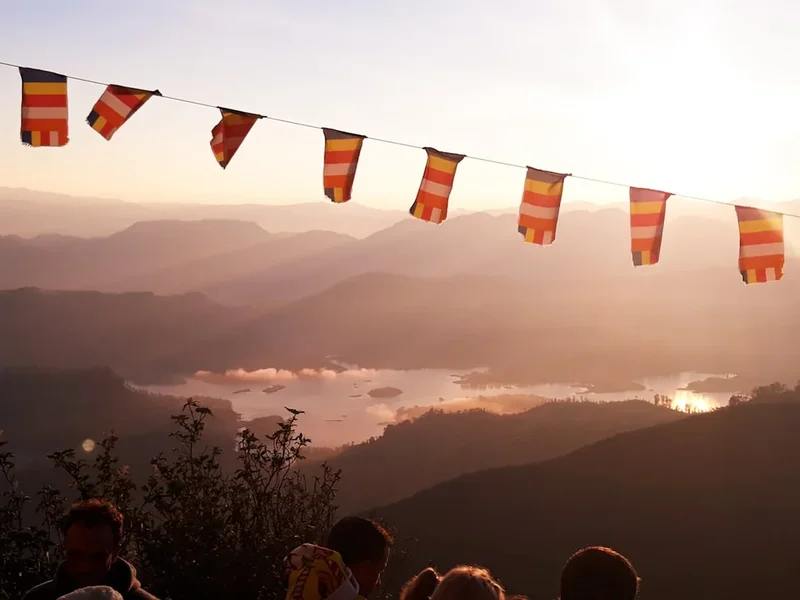
Adam's Peak (Sri Pada) - The Sacred Ascent
Adam's Peak, known locally as Sri Pada ("Sacred Footprint"), is a 2,243-metre tall conical mountain located in the central highland region of Sri Lanka. It is not merely a geographical landmark but a profound spiritual beacon that has drawn pilgrims for over a thousand years. The mountain is unique globally for being sacred to four major religions: Buddhists believe the 1.8-metre rock formation at the summit is the footprint of the Buddha; Hindus attribute it to Lord Shiva (Sivan Oli Padam); Muslims and Christians traditionally associate it with the place where Adam first set foot on Earth after being cast out of Eden. This shared reverence creates a trekking experience unlike any other, where the physical challenge of ascending thousands of stone steps is intertwined with a deep sense of communal devotion and ancient tradition.
- Distance: 7.0 km (Hatton-Nallathanniya route, one way)
- Elevation Gain: 1,000 m
- Duration: 4–7 hours for the ascent; 2–3 hours for the descent
- Difficulty: Challenging (primarily due to the relentless verticality of the steps)
- Best Time: December to April (Pilgrimage season)
- Highest Point: 2,243 m (Summit)
- Total Steps: Approximately 5,000 to 6,000 depending on the specific path
- Access: Most commonly accessed via the town of Dalhousie (Nallathanniya)
Overview
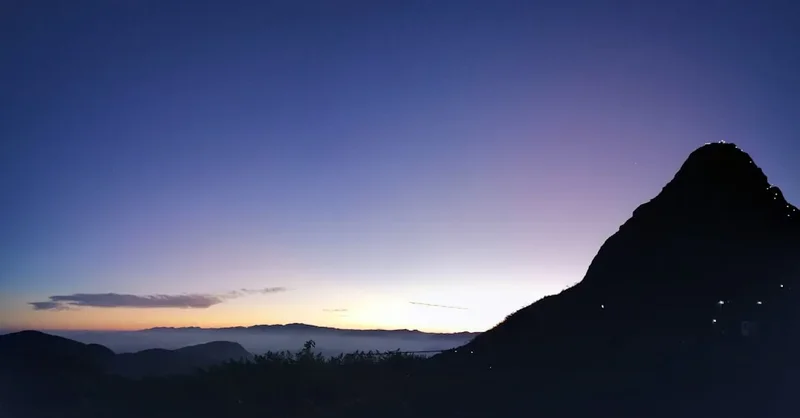
Rising sharply from the lush emerald rainforests of the Peak Wilderness Sanctuary, Adam's Peak is one of Sri Lanka's most striking natural features. Its perfectly symmetrical conical shape makes it visible from the coast on clear days, and its summit offers a 360-degree panorama of the central highlands, tea estates, and distant reservoirs. However, the "trail" is not a traditional dirt path; it is a monumental staircase carved into the mountainside, illuminated by a string of lights that snakes up the ridge like a glowing serpent during the pilgrimage season. This illumination allows for the traditional night-time ascent, timed so that hikers reach the summit just before dawn to witness the "Ira Sewaya"—the spectacular sunrise.
The climb is a test of physical endurance and mental resolve. Unlike alpine treks that involve switchbacks and gradual gradients, Adam's Peak is a direct, vertical assault. The steps vary in height and condition, ranging from broad concrete tiers at the base to narrow, steep, and uneven stone blocks near the summit. During the peak season (December to April), the trail becomes a living river of humanity. You will walk alongside elderly pilgrims climbing barefoot, parents carrying infants, and saffron-robed monks, all moving toward the summit shrine. The atmosphere is one of quiet determination, punctuated by the rhythmic chanting of "Karunawai" (peace/kindness) and the occasional ringing of the summit bell.
Beyond the religious significance, the mountain is a biodiversity hotspot. The surrounding Peak Wilderness Sanctuary is one of the last remaining strongholds of the Sri Lankan leopard and home to numerous endemic bird species and amphibians. As you ascend, the vegetation transitions from lowland tropical rainforest to stunted montane "cloud forest," where trees are draped in moss and lichens, thriving in the cool, misty air of the high altitudes. Whether you seek spiritual enlightenment, a physical challenge, or simply the most breathtaking sunrise in the Indian Ocean, Adam's Peak delivers an experience that lingers long after the muscle soreness fades.
History and Cultural Context
The history of Adam's Peak is a tapestry of myth, legend, and recorded historical accounts that span millennia. The earliest references to the mountain as a site of pilgrimage date back to the reign of King Vijayabahu I (1055–1110 AD), who is credited with building shelters and providing for the needs of pilgrims. Subsequent Sinhalese kings, including Parakramabahu II and Nissanka Malla, made the arduous journey to the summit, leaving behind inscriptions and stone carvings that document their devotion. The mountain was so significant that it was often used as a symbol of the king's sovereignty over the island.
For Buddhists, the mountain's sanctity stems from the belief that the Buddha, during his third visit to Sri Lanka, left his footprint on the summit at the request of the local deity, Saman. This deity is still worshipped today as the protector of the mountain, and pilgrims often stop at shrines dedicated to Saman (Saman Devalaya) at the base of the trail. Hindus, meanwhile, identify the footprint as the "Sivan Oli Padam," the creative dance of Lord Shiva. The Islamic and Christian traditions, which gained prominence during the colonial era and through the accounts of early travellers, suggest that the mountain was the site of Adam's first penance on Earth, a belief that gave the peak its English name.
International travellers have been fascinated by the peak for centuries. The famous Moroccan explorer Ibn Battuta climbed the mountain in 1344, providing a detailed account of the chains used to assist climbers on the steeper sections—chains that are still visible today and are traditionally attributed to Alexander the Great. Marco Polo also mentioned the mountain in his writings, though it is debated whether he actually made the ascent. During the British colonial period, the mountain became a popular destination for surveyors and tea planters, who established the nearby estates that still dominate the landscape. Today, the mountain remains a powerful symbol of Sri Lanka's multi-religious identity, where people of different faiths share the same path in a rare display of religious harmony.
Want more background? Read extended notes on history and cultural context → Learn more
Seasonal Highlights and Weather Reality
The experience of climbing Adam's Peak is fundamentally defined by the season. The official pilgrimage season begins on the Unduvap Poya (the full moon in December) and continues until the Vesak Poya (the full moon in May). During this window, the weather is generally at its driest, the trail is fully illuminated at night, and all the small tea shops (ambalamas) along the route are open, providing refreshments and rest areas.
The Pilgrimage Season (December to April): This is the best time for most hikers. The skies are usually clear, offering the highest probability of seeing the famous sunrise and the triangular shadow of the peak cast across the clouds. However, this is also the time of extreme crowds. On weekends and Poya (full moon) days, the trail can become so congested that the final ascent takes hours of standing in a slow-moving queue. If possible, plan your climb for a weekday during this period to avoid the heaviest traffic.
The Off-Season (May to November): Climbing during the off-season is a completely different undertaking. The lights are turned off, the shops are boarded up, and the summit shrine is often closed. The Southwest Monsoon brings heavy rains, high winds, and thick mist to the region, making the steps slippery and the views non-existent. Leeches become a significant nuisance in the lower sections. Only experienced hikers with high-quality headlamps and wet-weather gear should attempt the climb during this time. The reward is absolute solitude, but the risks are significantly higher.
Weather Reality: Regardless of the season, the temperature at the summit is significantly lower than at the base. While Dalhousie might be a balmy 20°C, the summit can drop to 5°C or lower before dawn, especially with the wind chill. Rain can occur at any time in the hill country, so a waterproof layer is essential even in the "dry" season. The mist can roll in within minutes, obscuring the trail and the views, requiring hikers to be cautious on the descent.
Recommended Itinerary
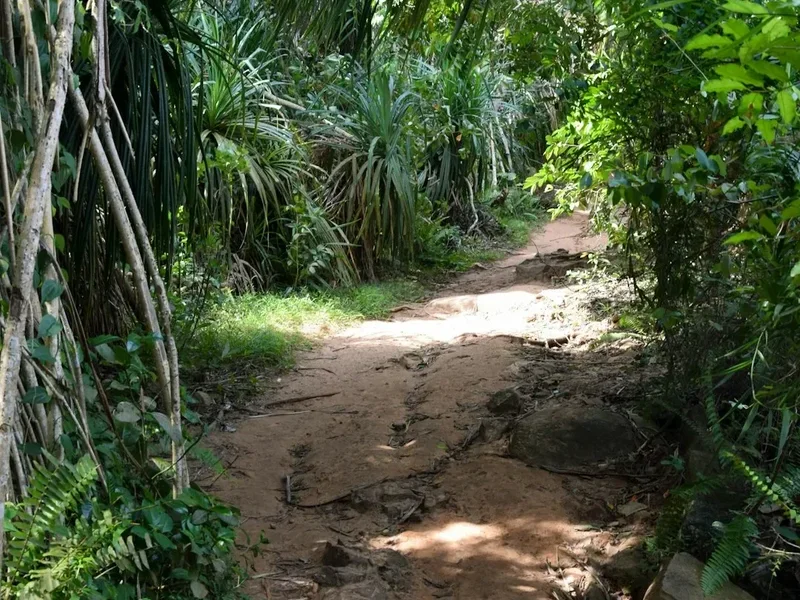
Standard Night Ascent (Hatton Route)
Phase 1: The Midnight Start (Dalhousie to Peace Pagoda)
- Distance: 1.5 km
- Elevation gain: 150 m
- Time: 45 minutes – 1 hour
- Start from Dalhousie (Nallathanniya) trailhead around 1:00 AM or 2:00 AM
- Pass through the entrance archway and the initial cluster of shops and stalls
- The path begins as a gentle incline on a wide, paved surface
- Reach the Japanese Peace Pagoda, a large white stupa that marks the end of the easy section
- Pause here to adjust layers and ensure your headlamp is ready if the trail lights are dim
Phase 2: The Middle Ascent (Peace Pagoda to Seetha Gangula)
- Distance: 2.5 km
- Elevation gain: 350 m
- Time: 1.5 – 2 hours
- The gradient increases as the stone steps become more frequent and steeper
- Pass through forested sections where the sound of rushing water is audible
- Reach Seetha Gangula (the "icy stream"), a traditional stopping point where pilgrims wash their faces or bathe in the cold mountain water
- This is a good place for a longer break and a snack before the final, most difficult section
- The air begins to cool noticeably here
Phase 3: The Final Push (Seetha Gangula to Summit)
- Distance: 3.0 km
- Elevation gain: 500 m
- Time: 2 – 3 hours (can be longer if crowded)
- The steps become very steep, narrow, and relentless—this is the "Ahala Kanuwa" section
- Handrails are provided on both sides; use them, as the steps can be uneven
- The trail passes through the "Last Shop" area where you can get a final hot tea
- The final 500 metres are often a slow crawl due to the number of people
- Arrive at the summit (2,243 m) at least 30 minutes before sunrise (usually around 5:30 AM – 6:00 AM)
Phase 4: The Summit and Descent
- Time at Summit: 1 hour
- Descent Time: 2 – 3 hours
- Witness the sunrise and the ritual ringing of the bell (once for every time you have climbed)
- Observe the "Shadow of the Peak" phenomenon on the opposite side of the mountain
- Begin the descent as soon as the sun is up to avoid the heat
- The descent is notoriously hard on the knees; take frequent breaks
- Return to Dalhousie for a well-earned breakfast by 9:00 AM or 10:00 AM
Important Notes:
- The Ratnapura (Palabaddala) route is much longer (approx. 12 km) and takes 7–10 hours; it is only recommended for very fit hikers seeking a more rugged experience
- On weekends, start even earlier (midnight or 11:00 PM) to account for "traffic jams" on the steps
- The summit area is a religious shrine; you must remove your shoes before entering the immediate footprint area
- Keep left on the stairs to allow descending pilgrims to pass
Planning and Bookings
Book Your Trip
Everything you need to plan your journey
Accommodation
Find places to stay near Ratnapura
Flights
Search flights to Ratnapura
Essential Preparation
Planning for Adam's Peak is less about booking permits and more about physical preparation and logistical timing. There is no official booking system or entry fee for the mountain, making it one of the most accessible major treks in Asia. However, your fitness level is the primary consideration. You will be climbing over 5,000 steps in a single night; if you have knee issues or a low level of cardiovascular fitness, this trail will be exceptionally punishing. It is recommended to do some stair-climbing or hill-walking in the weeks leading up to your trip.
The logistical hub for the most popular route is the small village of Dalhousie (also known as Nallathanniya). To get there, most travellers take the train to Hatton (on the scenic Colombo-Kandy-Ella line) and then a local bus or a tuk-tuk for the remaining 30 kilometres. The bus ride from Hatton takes about 1.5 to 2 hours and winds through stunning tea plantations. During the pilgrimage season, buses run frequently, but they can be very crowded. If you are coming from the south, you would head to Ratnapura, but this route is significantly more demanding and less common for first-time visitors.
Trail Accommodation
There is no accommodation on the mountain itself. Pilgrims sometimes sleep in the "ambalamas" (rest sheds) along the trail, but these are basic concrete shelters and are usually packed with people. For most hikers, the strategy is to stay in Dalhousie and begin the climb in the middle of the night.
Dalhousie Accommodation:
- Numerous guesthouses and "hotels" line the main road in Dalhousie
- Options range from very basic rooms with shared bathrooms to mid-range guesthouses with hot water
- During the peak season, it is highly recommended to book at least a few days in advance
- Most guesthouses are accustomed to the midnight start and can arrange early wake-up calls or packed snacks
- Prices are generally higher during the pilgrimage season but remain affordable by international standards
What Accommodation Provides:
- A place to leave your main luggage while you climb
- A bed for a few hours of sleep before the midnight start
- Usually, a restaurant on-site for a pre-climb meal
- Hot showers (essential for when you return, exhausted and cold)
Required Gear
- Footwear: While many locals climb barefoot or in flip-flops, high-quality trainers or hiking shoes with good grip are strongly recommended. The steps can be slippery when wet or worn smooth.
- Layered Clothing: This is critical. You will sweat profusely during the ascent, but you will freeze while waiting for the sunrise at the summit. Bring a moisture-wicking base layer, a warm fleece or down jacket, and a windproof/waterproof outer shell.
- Headlamp: Even though the trail is lit during the season, the lights can fail, or certain sections may be dim. A headlamp is essential for safety, especially in the off-season.
- Knee Support: If you have sensitive knees, consider wearing compression sleeves or using trekking poles (though poles can be cumbersome on the narrow steps).
- Small Backpack: A 15–20L daypack is sufficient to carry your layers, water, and snacks.
What to Bring
- Water: At least 2 litres per person. While there are shops along the way, prices increase with altitude, and you want to ensure you stay hydrated.
- Snacks: Energy-dense foods like nuts, chocolate, bananas, or energy bars. A hot tea at a trailside shop is a great morale booster.
- Cash: Small denominations of Sri Lankan Rupees for tea, snacks, and donations at the temples. There are no ATMs in Dalhousie, so withdraw cash in Hatton.
- Toiletries: Tissues or toilet paper (toilets along the trail are very basic), hand sanitiser, and sunblock for the descent.
- Spare Socks: If your feet get wet or excessively sweaty, a fresh pair of socks for the summit or the descent can prevent blisters.
- Earplugs: If you plan to sleep in Dalhousie during the day, the village can be very noisy with chanting and music during the season.
Permits
One of the unique aspects of Adam's Peak is that no official permit or entry fee is required for either local or international visitors. The mountain is open to all as a site of public and religious heritage. However, there are several cultural and informal "permits" of sorts that you should be aware of to ensure a respectful and smooth journey.
The Donation System: Near the start of the trail, you will likely encounter monks or volunteers asking for donations to maintain the path or the summit shrine. You may be asked to sign a ledger and will often receive a piece of white string tied around your wrist as a blessing. While not mandatory, a small donation (e.g., 500–1,000 LKR) is a respectful gesture and contributes to the upkeep of the thousands of steps you are about to use.
Cultural Etiquette: The summit is a highly sacred site. You must remove your shoes and hat before entering the upper sanctum where the footprint is housed. Ensure your shoulders and knees are covered (carrying a sarong is a good idea). Photography is generally allowed on the trail and at the summit for the views, but taking photos of the actual "footprint" inside the shrine is often discouraged or prohibited—look for signs or observe the locals.
Off-Season Access: During the off-season (May to November), there are no formal restrictions on climbing, but the lack of lights and facilities means you are climbing at your own risk. It is wise to inform your guesthouse host of your plans and expected return time, as the mountain can be dangerous in bad weather.
Other Activities in the Area
The region around Adam's Peak is part of Sri Lanka's stunning Hill Country, offering plenty of reasons to stay an extra day or two:
- Tea Estate Tours: The drive from Hatton to Dalhousie passes through some of the world's finest tea country. Many factories, such as the Devon or St. Clair estates, offer tours where you can learn about the processing of Ceylon tea and enjoy a tasting session.
- Laxapana Falls: Located a short drive from Dalhousie, this is one of the highest waterfalls in Sri Lanka (126 m). It is a powerful and beautiful site, often much less crowded than the mountain itself.
- Aberdeen Falls: Another spectacular waterfall in the vicinity, offering a great spot for photography and a refreshing dip in the lower pools (be careful of currents).
- Castlereagh Reservoir: A stunning body of water surrounded by tea-covered hills. You can take a boat ride or simply enjoy the views from the road. It is also the site where seaplanes from Colombo land.
- The Train Journey: The rail segment between Kandy and Hatton is widely considered one of the most beautiful train rides in the world. Ensure you book a seat in advance or be prepared to stand by the open doors for the best views.
- Nuwara Eliya: Known as "Little England," this colonial-era hill station is about 2–3 hours away and offers golf courses, rose gardens, and a significantly cooler climate.
Safety and Conditions
Physical Strain: The primary safety concern on Adam's Peak is the sheer physical toll of the steps. "Jelly legs" are a common phenomenon on the descent, which can lead to trips and falls. Take the descent slowly, use the handrails, and don't be afraid to take frequent breaks. Dehydration and low blood sugar can also lead to dizziness; eat and drink regularly even if you don't feel hungry in the cold air.
Crowd Management: During peak times, the density of people on the narrow upper steps can be overwhelming. If you suffer from claustrophobia, avoid Poya days. In the event of a "standstill" in the queue, stay calm, keep your warm layers on, and wait patiently. Do not try to climb over railings or bypass the queue, as this is dangerous and disrespectful.
Weather Hazards: The weather can change with incredible speed. If a thunderstorm begins while you are on the upper sections, the metal handrails can become a lightning hazard. In extremely high winds or heavy rain, it is often safer to turn back. Hypothermia is a genuine risk at the summit if you are wet and under-dressed; always carry a dry spare layer in a waterproof bag.
Wildlife: In the lower, forested sections, leeches are common, especially after rain. While they are harmless, they can be off-putting. Use salt, lime, or specialized leech socks to deter them. While leopards exist in the sanctuary, they are incredibly elusive and avoid the noisy, lit-up trail. You are far more likely to encounter monkeys; do not feed them, as they can become aggressive.
Emergency Services: There are basic medical outposts along the trail during the pilgrimage season, usually manned by volunteers or the military. However, for any serious injury, evacuation is difficult and involves being carried down the steps by hand. Ensure you have comprehensive travel insurance that covers trekking and medical evacuation.
Side Trips and Points of Interest
The Japanese Peace Pagoda: Located about 45 minutes into the climb, this beautiful white stupa was built by the famous Japanese Buddhist monk Nichidatsu Fujii. It stands as a monument to world peace and offers a serene place to pause. The views of the peak from here, especially when it is illuminated at night, are iconic.
Seetha Gangula: This "icy stream" is a traditional milestone. Pilgrims believe the water is exceptionally pure. You will see many people performing ritual ablutions here. It marks the transition from the "easier" lower slopes to the serious climbing of the upper mountain.
The Shadow of the Peak: This is perhaps the most famous "extra" of the Adam's Peak experience. As the sun rises, it casts a perfect, dark triangular shadow of the mountain onto the clouds or the mist on the opposite side (the western side). What makes it remarkable is that the shadow remains perfectly triangular even though the mountain itself is not a perfect cone. It is a fleeting phenomenon that lasts only a few minutes after sunrise.
The Summit Bell: Once you reach the top and pay your respects at the shrine, it is tradition to ring the large bronze bell. The rule is to ring it once for every successful ascent you have made. You will hear the bell tolling throughout the morning—some elderly pilgrims ring it dozens of times, a testament to a lifetime of devotion.
The Ratnapura Route (Palabaddala): For those who find the Hatton route too "touristy," the Ratnapura route offers a much more wilderness-oriented experience. It is longer, steeper, and passes through much denser jungle. It is the traditional route used by ancient kings and offers a deeper immersion into the Peak Wilderness Sanctuary.
Leave No Trace
Adam's Peak faces a massive environmental challenge. With hundreds of thousands of pilgrims visiting each year, the amount of waste—particularly plastic—is staggering. As a responsible hiker, you must play your part in preserving this sacred and ecologically sensitive area.
Your responsibility as a hiker:
- Carry Out All Trash: Do not leave even a single sweet wrapper or plastic bottle on the mountain. There are bins, but they are often overflowing; it is much better to carry your waste back to Dalhousie.
- Avoid Single-Use Plastics: Bring a reusable water bottle. Many guesthouses in Dalhousie provide filtered water refills. Avoid buying plastic-wrapped snacks if possible.
- Stay on the Steps: The surrounding forest is a protected sanctuary. Stepping off the path tramples rare plants and contributes to soil erosion.
- Respect the Silence: While the trail is social, avoid loud music or shouting. Many people are on a spiritual journey; respect their need for quiet reflection.
- No Graffiti: It should go without saying, but do not carve names or messages into the stones, railings, or trees.
- Use Toilets Provided: Use the designated toilet blocks, however basic they may be. Do not relieve yourself in the forest or near the streams, as these are sources of drinking water for the communities below.
The phrase "Take nothing but pictures, leave nothing but footprints" is particularly poignant here, where the "footprint" we should be focused on is the sacred one at the summit, not our own environmental one.
 Japan
Japan